
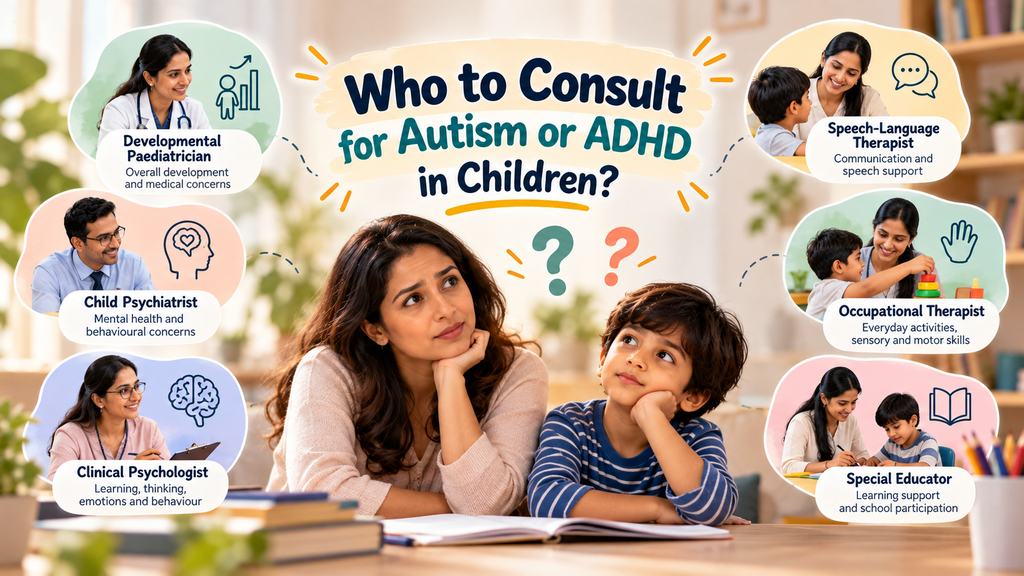
Who to Consult for Autism or ADHD: Understanding the Six Professional Roles
1. Developmental Paediatrician: Understanding the Child’s Overall Development
A developmental paediatrician is a medical doctor with specialised training in child development and developmental conditions. Depending on their training and clinical experience, they may assess developmental delays, autism, ADHD, learning-related developmental concerns, and other neurodevelopmental presentations.
When might parents consider consulting one?
- Delays in speech, language, movement, or other developmental milestones.
- Differences in social communication or interaction.
- Persistent difficulties with attention, activity levels, or impulse control.
- Delays or differences affecting several areas of development.
- Concerns about development that require a broader medical and developmental assessment.
What does the assessment involve?
The clinician may review the child’s developmental history, medical history, behaviour, milestones, and functioning across home and school. They may use developmental screening or assessment tools, conduct a clinical examination, and recommend further assessments or referrals where needed.
Lipkin and Macias (2020) emphasised that developmental concerns identified during routine healthcare visits should be followed by appropriate screening, evaluation, and referral when indicated.
A developmental paediatrician may coordinate aspects of a child’s care, but the exact role depends on the clinician’s expertise and local services. Not every developmental paediatrician provides every type of diagnostic assessment.
What parents should remember: A developmental paediatrician can help families understand a child’s developmental profile and decide what further assessment or support may be appropriate.
2. Child and Adolescent Psychiatrist: Understanding Mental Health and Behavioural Concerns
A child and adolescent psychiatrist is a medical doctor specialising in the mental health of children and adolescents.
Parents sometimes associate psychiatry only with medication. However, child psychiatry also involves clinical assessment, understanding emotional and behavioural difficulties, considering co-occurring conditions, and developing an appropriate management plan.
When might parents consider consulting one?
A child psychiatrist may be particularly helpful when a child experiences:
- Significant anxiety, persistent low mood, or emotional distress.
- Severe difficulties with emotional regulation or behaviour.
- ADHD-related difficulties that substantially affect daily functioning.
- Sleep or other concerns that need assessment in the context of mental health.
- Possible co-occurring mental health conditions alongside autism or ADHD.
What does the assessment involve?
The psychiatrist may speak with parents and, where appropriate, the child; review developmental and family history; examine symptoms across different settings; and consider other explanations for the difficulties. They may recommend psychological interventions, family support, school-based adjustments, medication when clinically indicated, or collaboration with other professionals.
Hyman et al. (2020), in the AAP’s clinical report on autism identification and management, emphasised the importance of recognising co-occurring conditions and ensuring that children can access appropriate medical and mental health care.
A child psychiatrist may assess and diagnose ADHD or other conditions within their competence. Autism assessment may also fall within their scope when they have appropriate training and experience.
What parents should remember: Consulting a psychiatrist does not automatically mean that a child will be prescribed medication. The purpose is to understand the child’s needs and consider suitable options.
3. Clinical Psychologist: Understanding Learning, Thinking, Emotions, and Behaviour
A clinical psychologist is trained to assess psychological functioning and provide appropriate psychological interventions within their professional competence.
In children, this may include understanding cognitive abilities, learning difficulties, emotional functioning, adaptive skills, and behavioural patterns. Some clinical psychologists have additional expertise in autism, ADHD, developmental assessment, or neuropsychological assessment.
When might parents consider consulting one?
A clinical psychologist may be helpful when parents or professionals have questions about:
- Whether a child may have ADHD, autism, or another developmental or psychological condition.
- The child’s cognitive abilities, learning profile, or adaptive functioning.
- Difficulties with attention, emotional regulation, anxiety, or behaviour.
- Strengths and support needs that may influence learning and daily life.
- The need for a comprehensive psychological assessment.
What does the assessment involve?
Depending on the referral question, the psychologist may use interviews, behavioural observations, standardised psychological tests, developmental history, and information from parents or teachers.
It is important to distinguish screening from diagnosis. A screening questionnaire can indicate that further evaluation may be appropriate; it does not establish a diagnosis on its own.
Hyman et al. (2020) describe autism identification as a clinical process that draws on developmental history, observation, and assessment of relevant characteristics. NICE (2011) likewise recommends that autism diagnostic assessment be undertaken by appropriately trained professionals working within a suitable multidisciplinary pathway.
A clinical psychologist’s scope depends on their qualifications, training, experience, and applicable professional requirements. Not every clinical psychologist specialises in diagnosing autism or ADHD, and not every assessment requires the same tests.
What parents should remember: Ask what question the assessment is intended to answer, which methods will be used, and how the findings will guide practical support for your child.
4. Speech-Language Therapist: Supporting Communication
Speech-language therapists assess and support communication and, where within their professional scope, feeding and swallowing difficulties. In India, the profession is also commonly referred to as speech and language pathology, and the professional may be called a speech-language pathologist (SLP).
Communication involves more than speaking words. A child may use gestures, facial expressions, pictures, signs, speech-generating devices, or other forms of communication.
When might parents consider consulting one?
A speech-language therapist may be helpful when a child:
- Is speaking fewer words than expected or has difficulty combining words.
- Finds it difficult to understand spoken language.
- Has difficulty expressing needs, ideas, or feelings.
- Struggles with conversational turn-taking or the social use of communication.
- Has speech-sound or fluency difficulties.
- Could benefit from augmentative and alternative communication (AAC).
What does the assessment involve?
The therapist may assess receptive language (understanding), expressive language (communicating), speech production, and social communication. Depending on the child’s needs, they may recommend individual sessions, caregiver coaching, communication strategies, or AAC.
The AAP’s clinical guidance on autism recognises the importance of assessing communication and connecting children with appropriate intervention and educational services (Hyman et al., 2020).
A key point for parents is that a child does not need to speak before being supported to communicate. AAC may be considered when appropriate, including for children who use little or no spoken language.
Speech-language therapy is not limited to autistic children. It can also support children with language delays, speech difficulties, and other communication needs.
What parents should remember: The goal is meaningful communication, participation, and the ability to express needs, not simply increasing the number of spoken words.
5. Occupational Therapist: Supporting Everyday Activities and Participation
Occupational therapists help children participate in everyday activities. These may include dressing, eating, playing, writing, managing school routines, and other tasks that matter to the child and family.
Some occupational therapists have specialised experience in paediatrics, sensory processing, motor coordination, or developmental conditions.
When might parents consider consulting one?
An occupational therapist may be helpful when a child:
- Finds dressing, grooming, or other daily routines difficult.
- Has challenges with handwriting, fine-motor coordination, or using classroom materials.
- Struggles with motor planning or coordinating movements.
- Experiences sensory-related differences that affect participation in daily activities.
- Finds certain school, play, or self-care tasks unusually difficult.
What does the assessment involve?
The occupational therapist may examine how the child performs everyday tasks, their motor abilities, the demands of the environment, and factors that make activities easier or harder.
Support may include practising daily living skills, adapting activities, recommending appropriate environmental changes, or helping families and teachers develop practical strategies.
NICE (2013) includes occupational therapy within the broader multidisciplinary support landscape for autistic children and young people, with services tailored to individual needs.
Sensory differences should be understood in the context of the child’s actual experiences and functional needs. Not every sensory preference requires therapy, and the value of an intervention should be evaluated against meaningful goals.
What parents should remember: Occupational therapy should help the child participate more comfortably and independently in everyday life, with goals that matter to the child and family.
6. Special Educator: Supporting Learning and School Participation
A special educator supports children who need individualised approaches, accommodations, or specialised instruction to access learning.
Special educators may work in schools, early-intervention settings, resource rooms, or other educational environments. Their qualifications, training, and responsibilities vary by setting and role.
When might parents consider consulting one?
A special educator may be helpful when a child:
- Struggles to access the regular classroom curriculum.
- Needs individualised teaching strategies or learning goals.
- Has difficulty following classroom routines or multistep instructions.
- Requires adjustments to teaching materials, task presentation, or assessment.
- Needs support with foundational academic, communication, organisational, or functional learning skills.
What does the support involve?
A special educator may assess educational needs, identify learning strengths and barriers, adapt instructional approaches, break tasks into manageable steps, and collaborate with parents and school staff.
For example, a child who finds written instructions overwhelming may benefit from visual supports, shorter task sequences, additional processing time, or alternative ways to demonstrate understanding.
In India, the Rights of Persons with Disabilities Act, 2016, and the National Education Policy, 2020, provide important policy contexts for disability inclusion and educational support. The specific accommodations and services available depend on the child’s needs, school context, and applicable provisions.
Special education is not limited to children with a formal autism or ADHD diagnosis. Educational support can be considered when a child has identified learning needs, subject to the school’s processes and applicable requirements.
What parents should remember: A special educator focuses on access to learning and participation in education. They complement, rather than replace, appropriate medical or psychological assessment when that is needed.
How Do Parents Decide Which Professional to Consult First?
There is no single starting point that is right for every child. The most appropriate professional depends on the concern, the child’s age, the urgency of the situation, and the services available locally.
The following examples can help parents think about a possible first step.
| If your main concern is… | A professional to consider |
| Delays across several developmental areas | Developmental paediatrician |
| Possible autism or ADHD requiring assessment | A qualified clinician experienced in the relevant diagnostic assessment |
| Significant emotional or mental health difficulties | Child and adolescent psychiatrist or clinical psychologist, depending on the concern |
| Speech, language, or communication difficulties | Speech-language therapist |
| Daily living, fine-motor, or participation difficulties | Paediatric occupational therapist |
| Learning needs or classroom participation | Special educator |
These are starting points, not rigid rules. A paediatrician or another qualified healthcare professional may help determine which specialist is most appropriate. Parents can also seek communication or educational support while a diagnostic assessment is being arranged.
The AAP recommends referral for appropriate developmental evaluation and early-intervention services when developmental concerns are identified, rather than making families wait for every diagnostic question to be resolved (Lipkin & Macias, 2020).
Why a Multidisciplinary Approach Can Help
Autism and ADHD can affect children in different ways. A child may have communication differences, attention difficulties, sensory preferences, learning needs, or co-occurring emotional or developmental concerns. No single professional necessarily has the expertise to address every aspect.
NICE (2011) recommends multidisciplinary autism assessment involving relevant medical, psychological, and speech-language professionals, with access to additional expertise such as occupational therapy when needed.
For example, consider a child who has limited spoken language, finds noisy classrooms overwhelming, and struggles to complete learning tasks.
- A developmental paediatrician may review the child’s overall development and medical history.
- A clinical psychologist with relevant expertise may assess cognitive, adaptive, or diagnostic questions.
- A speech-language therapist may assess communication and explore suitable communication supports.
- An occupational therapist may assess difficulties participating in everyday activities.
- A special educator may adapt teaching approaches and classroom materials.
- A child psychiatrist may be involved if significant co-occurring mental health or behavioural concerns require psychiatric assessment.
Not every child needs all six professionals. The purpose of collaboration is to bring in the right expertise for the child’s actual needs, not to accumulate appointments or interventions.
What Should Parents Check Before Choosing a Professional?
Before booking an appointment, consider asking the following questions:
- What are your qualifications? Check the professional’s relevant degree, recognised registration where applicable, and current professional standing.
- Do you have experience with my child’s concern and age group? Experience working with children does not automatically mean expertise in autism, ADHD, or every developmental condition.
- What will the assessment or consultation involve? Ask about interviews, observations, tests, reports, and the information you may need to bring.
- What will happen after the assessment? Clarify whether you will receive written findings, practical recommendations, referrals, or a follow-up plan.
- Do you collaborate with other professionals? Coordinated care can be valuable when a child’s needs extend across development, communication, mental health, and education.
- How will progress be evaluated? For intervention services, ask how goals will be agreed upon and reviewed.
In India, parents can check relevant professional registration and qualifications through the applicable regulatory body. For example, the Rehabilitation Council of India maintains registration requirements for professionals and categories covered by its mandate. Parents should verify the specific professional category rather than assuming that every title is regulated in the same way.
Be cautious of anyone who promises a guaranteed cure for autism or ADHD, guarantees a diagnosis, or recommends expensive programmes without explaining their purpose, evidence, risks, and alternatives.
Frequently Asked Questions
1. Should I consult a developmental paediatrician or a child psychiatrist for ADHD?
Either may be an appropriate starting point, depending on the child’s needs and the clinician’s expertise. A developmental paediatrician may be particularly helpful when broader developmental questions are present. A child psychiatrist may be helpful when significant emotional or mental health concerns coexist. Confirm that the professional has the training and experience to assess ADHD.
2. Can a clinical psychologist diagnose autism or ADHD?
A suitably qualified and experienced clinical psychologist may conduct diagnostic assessments within their professional scope and applicable requirements. The assessment process, permitted scope, and role in issuing formal documentation can vary by jurisdiction and service setting. Ask the clinician about their specific qualifications and the nature of the report they provide.
3. Does my child need a diagnosis before starting speech or occupational therapy?
Not necessarily. When a developmental or functional need is identified, appropriate support may begin before a diagnostic evaluation is complete. The AAP recommends connecting children with identified developmental concerns to appropriate intervention and early-childhood services without unnecessarily waiting for a final diagnosis (Lipkin & Macias, 2020). The suitability of any service should be assessed individually.
4. Does every autistic child need all these professionals?
No. Autistic children have different strengths, preferences, and support needs. Some may benefit from speech-language therapy, some from educational accommodations, and others from support with daily activities or co-occurring mental health concerns. Services should be based on individual needs and reviewed over time.
5. Who should I consult if I suspect both autism and ADHD?
Consider a clinician or service experienced in assessing both conditions, or begin with a qualified developmental or mental healthcare professional who can guide referrals. Autism and ADHD can co-occur, so the assessment should consider the child’s developmental history and functioning across settings rather than assuming that one explanation accounts for every difficulty.
Conclusion: The Right Support Begins With Understanding
When parents first notice developmental or behavioural differences, it is natural to feel uncertain about where to begin. Understanding the roles of different professionals can make the process less overwhelming.
A developmental paediatrician may help with broader developmental concerns. A child psychiatrist can assess mental health needs. A clinical psychologist may evaluate psychological functioning and relevant diagnostic questions. Speech-language therapists support communication, occupational therapists support everyday participation, and special educators help children access learning.
These roles can overlap, and collaboration may be valuable. What matters most is finding appropriately qualified professionals who listen to the family, recognise the child’s strengths, explain their recommendations, and work towards meaningful, individualised goals.
At NeuroNestHub, we believe that parents deserve clear, reliable information to help them make informed decisions. Seeking guidance is not about labelling a child or trying to make every child fit the same expectations. It is about understanding the child and identifying support that helps them communicate, learn, participate, and thrive.
A note for parents: This article is for educational and awareness purposes only. It does not provide an individual diagnosis or replace professional assessment. The appropriate pathway depends on the child’s circumstances and local services.
Discover real stories, practical resources, and a growing community at NeuroNestHub. If you have a story to share, we’d love to hear from you: https://neuronesthub.com/
References
American Academy of Paediatrics. (2020). Identification, evaluation, and management of children with autism spectrum disorder. Pediatrics, 145(1), Article e20193447. https://doi.org/10.1542/peds.2019-3447
Government of India. (2016). The Rights of Persons with Disabilities Act, 2016. https://www.indiacode.nic.in/
Government of India, Ministry of Education. (2020). National Education Policy 2020. https://www.education.gov.in/
Hyman, S. L., Levy, S. E., & Myers, S. M. (2020). Identification, evaluation, and management of children with autism spectrum disorder. Pediatrics, 145(1), Article e20193447. https://doi.org/10.1542/peds.2019-3447
Lipkin, P. H., & Macias, M. M. (2020). Promoting optimal development: Identifying infants and young children with developmental disorders through developmental surveillance and screening. Pediatrics, 145(1), Article e20193449. https://doi.org/10.1542/peds.2019-3449
National Institute for Health and Care Excellence. (2011). Autism spectrum disorder in under 19s: Recognition, referral and diagnosis (Clinical guideline CG128). https://www.nice.org.uk/guidance/cg128
National Institute for Health and Care Excellence. (2013). Autism spectrum disorder in under 19s: Support and management (Clinical guideline CG170). https://www.nice.org.uk/guidance/cg170
Rehabilitation Council of India. (n.d.). Rehabilitation Council of India. https://rehabcouncil.nic.in/