
Abstract
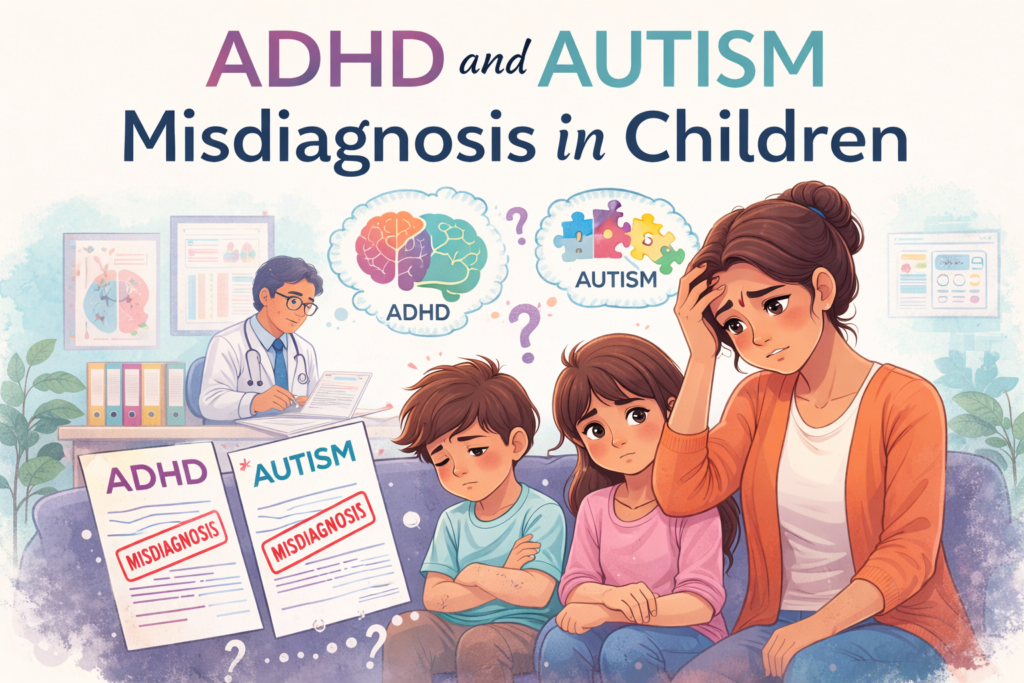
ADHD and Autism misdiagnosis is a growing concern in child development, driven by overlapping symptoms, evolving diagnostic criteria, and systemic limitations. Recent research (2019–2024) highlights how ADHD and autism misdiagnosis in children can delay intervention and negatively affect developmental outcomes. This article critically examines the causes, evidence, and, most importantly, the psychological, educational, and emotional impact of misdiagnosis on children and their families. The findings emphasise the urgent need for accurate, multidisciplinary diagnosis to improve long-term outcomes.
Introduction
Over the past decade, awareness around neurodevelopmental conditions has increased significantly. However, with increased awareness comes a parallel challenge: ADHD and Autism misdiagnosis.
Attention-Deficit/Hyperactivity Disorder (ADHD) and Autism Spectrum Disorder (ASD) are among the most commonly diagnosed childhood conditions. According to the Centers for Disease Control and Prevention, both conditions affect millions of children globally, yet distinguishing between them remains complex due to overlapping traits.
If you’re trying to clearly understand how these two conditions differ, you can read our detailed guide on Autism vs. ADHD: Key Differences Every Parent Should Know, where we break down the core distinctions parents often miss.
A recent systematic review confirms that children diagnosed with ADHD often display autistic traits, making the ADHD vs Autism diagnosis particularly challenging (Zhong & Porter, 2024) . This overlap contributes to both overdiagnosis and underdiagnosis, increasing the likelihood of children receiving the wrong label at critical developmental stages.
Why Misdiagnosis Happens
Symptom Overlap and Co-occurrence
ADHD and autism frequently co-occur, and their symptoms often “mask” each other. A 2024 review highlights how behavioural similarities, especially in attention and social functioning, make differentiation difficult, even for experienced clinicians.
Limitations of Diagnostic Methods
Diagnosis is largely based on behavioural observation rather than objective biological markers. As explained by the National Institute of Mental Health, there are currently no single medical tests to diagnose ADHD or autism definitively. This subjectivity increases the risk of misdiagnosed ADHD in children, especially when assessments are brief or incomplete. Sadek (2023) emphasises that a lack of medical evaluation can lead to diagnostic errors.
Developmental and School Factors
Children’s behaviour is often interpreted similarly to that of their peers. Younger children in a classroom may appear inattentive or impulsive simply due to developmental immaturity, leading to incorrect ADHD diagnosis.
Gender Bias
Girls are more likely to experience autism misdiagnosis because their symptoms may be less disruptive and more internalised. This results in delayed or incorrect diagnosis, often after years of struggle.
Many signs in girls are subtle and often overlooked, something we explore in detail in The Hidden Signs of Autism in Girls: What Recent Research Shows.
Impact of Misdiagnosis on Children

The consequences of ADHD and Autism misdiagnosis extend far beyond incorrect labelling; they fundamentally shape a child’s developmental trajectory.
1. Delayed Early Intervention
Early intervention is critical for both ADHD and autism. When a child is misdiagnosed, they may not receive the appropriate therapies during crucial developmental windows.
For example, a child with autism misdiagnosed as ADHD may receive behaviour management strategies but miss out on essential social communication support. Research shows that early targeted intervention significantly improve long-term outcomes in neurodevelopmental conditions.
2. Inappropriate Treatment and Medication Risks
Misdiagnosing ADHD in children often leads to stimulant medication that may not address the child’s actual needs. In autistic children, such treatment can sometimes increase anxiety, irritability, or sensory discomfort.
Similarly, children misdiagnosed with autism may not receive interventions targeting attention and executive functioning, leading to persistent academic struggles.
3. Academic and Learning Difficulties
A misdiagnosis can result in a mismatch between the child’s needs and the support provided in school.
- ADHD-focused strategies emphasise behaviour regulation.
- Autism-focused strategies emphasise communication and social skills.
When the diagnosis is incorrect, children often fall through the cracks. This can lead to poor academic performance, school avoidance, and even exclusion in some cases.
4. Emotional and Psychological Impact
Children who are misunderstood repeatedly may internalise negative beliefs about themselves.
They may experience:
- Low self-esteem
- Anxiety and frustration
- Identity confusion (“Why can’t I do what others can?”)
Over time, this can increase the risk of secondary mental health conditions such as depression.
5. Social Isolation and Peer Challenges
Social difficulties are common in both ADHD and autism, but for different reasons. Misdiagnosis means these differences are not properly addressed.
Children may struggle to:
- Build friendships
- Understand social cues
- Regulate emotional responses
This can lead to rejection, bullying, and long-term social withdrawal.
6. Co-occurring Health Issues Overlooked
Recent research highlights that children with overlapping ADHD and autism traits may also experience sleep disturbances, gastrointestinal issues, and emotional dysregulation .
Misdiagnosis can delay identification of these co-occurring conditions, worsening the child’s overall well-being.
Impact of Misdiagnosis on Families

The impact of misdiagnosis on families is profound, often extending beyond emotional stress into financial and relational strain.
1. Emotional Stress and Parental Guilt
Parents often sense that something is “not quite right,” but incorrect diagnoses can delay clarity for years.
A study on parent experiences found that families navigating ADHD or autism diagnoses frequently report confusion, frustration, and emotional exhaustion during the diagnostic journey .
Many parents also experience guilt, questioning whether they missed early signs or made wrong decisions. If this resonates with you, you’re not alone. Read our story on Parental Guilt After ADHD Diagnosis: Why It’s Not Your Fault, where we share a real experience many Indian parents will recognise.
2. Financial Burden
Misdiagnosis often leads to spending on ineffective therapies, repeated consultations, and multiple assessments.
In countries like India, where specialised services may already be limited, this burden becomes even more significant. We explore this in depth in our blog Why Indian Families Struggle to Raise Autistic and ADHD Children, highlighting the real challenges parents face in accessing support.
3. Breakdown of Trust in Systems
Repeated diagnostic changes can reduce trust in healthcare providers, schools, and therapists.
Parents may begin to:
- Question professional advice
- Delay further intervention
- Seek multiple opinions, increasing stress.
4. Impact on Parenting and Family Dynamics
Misdiagnosis affects how parents respond to their child’s behaviour.
Without understanding the root cause, parents may:
- Use ineffective discipline strategies.
- Misinterpret behaviours as intentional
- Experience increased conflict with the child.
Research also shows that parenting stress is significantly higher in families of neurodivergent children, particularly when support is inadequate.
5. Sibling and Family Relationships
The stress of managing unclear or changing diagnoses can affect the entire family.
- Siblings may feel neglected.
- Family routines may become strained.
- Emotional tension may increase at home.
Long-Term Consequences of Misdiagnosis
If left unaddressed, ADHD and autism misdiagnosis can have long-term implications:
- Delayed independence skills
- Poor academic and career outcomes
- Chronic mental health challenges
- Reduced quality of life
A 2024 case study demonstrated how a delayed autism diagnosis due to misclassification resulted in prolonged psychological distress and inappropriate interventions (Casey et al., 2024).
What Needs to Change
1. Multidisciplinary Diagnosis
Diagnosis should involve psychologists, paediatricians, speech therapists, and educators to capture the full picture.
2. Continuous Monitoring
Children should be reassessed as they grow, as symptoms evolve over time.
3. Improved Awareness
Parents and teachers must be educated about the differences between ADHD and autism to reduce early misinterpretation.
4. Better Diagnostic Tools
Emerging technologies and structured assessment tools can improve accuracy and reduce subjectivity.
Conclusion
ADHD and Autism misdiagnosis is not just a clinical issue, it is a deeply human one. It affects how children see themselves, how families function, and how society supports neurodiversity.
Research from recent years clearly shows that misdiagnosis can delay intervention, increase emotional distress, and create long-term challenges for both children and parents. However, with better awareness, comprehensive assessment, and early support, these outcomes can be significantly improved.
Accurate diagnosis is not just about labelling, it is about understanding a child’s unique needs and helping them thrive.
References
Casey, M. R., Sall, S., Parsons, G., Raveendran, K., & Zaheri, A. (2024). Misdiagnosis in an autistic adolescent. Cureus, 16(8), e68129. https://doi.org/10.7759/cureus.68129
Esposito, D., Bernardi, K., Belli, A., Gasparri, V., Romano, S., Terenzi, L., Zanatta, M. E., Iannotti, S., & Ferrara, M. (2024). The hidden impact of ADHD symptoms in preschool children with autism. Behavioral Sciences, 14(3), 211. https://doi.org/10.3390/bs14030211
Sadek, J. (2023). Attention deficit hyperactivity disorder misdiagnosis: Why medical evaluation should be a part of ADHD assessment. Brain Sciences, 13(11), 1522. https://doi.org/10.3390/brainsci13111522
Sainsbury, W. J., Bowden, C. J., Carrasco, K. D., Whitehouse, A. J. O., & Waddington, H. (2023). Parent experiences of their children’s diagnosis with autism, ADHD, or both. International Journal of Developmental Disabilities, 70(7), 1173–1183. https://doi.org/10.1080/20473869.2023.2166197
Zhong, Q., & Porter, M. (2024). Autism spectrum disorder symptoms in individuals with a primary diagnosis of ADHD: A systematic review. Review Journal of Autism and Developmental Disorders. https://doi.org/10.1007/s40489-024-00443-4
Martinez, S., Stoyanov, K., & Carcache, L. (2024). Unravelling the spectrum: Overlap, distinctions, and nuances of ADHD and ASD in children. Frontiers in Psychiatry. https://doi.org/10.3389/fpsyt.2024.1387179