
“My Child Is Smart… So Why Is It So Hard for Them to Focus?”
It’s one of the most common questions parents ask after their child is diagnosed with ADHD.
Your child understands what you are saying. They know they need to complete their homework, pack their school bag, or wait for their turn. Yet, they become distracted within minutes, forget simple instructions, or act before thinking.
It’s easy to assume they are careless, lazy, or simply not trying hard enough.
But research tells a different story.
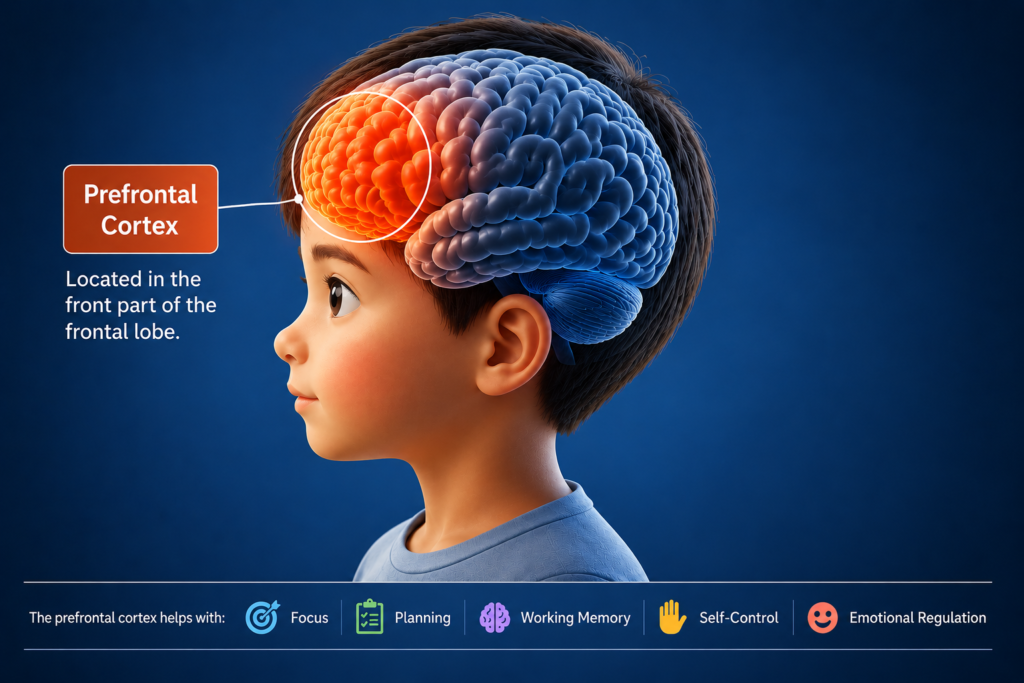
Many of these everyday challenges are linked to how a part of the brain called the prefrontal cortex develops and functions. Understanding the connection between the prefrontal cortex and ADHD helps us move beyond blaming behaviour and instead understand what is happening inside the brain.
Different brain regions support different skills. For example, while the prefrontal cortex is closely involved in attention, planning, and self-control, Broca’s area plays an important role in speech production and language. If you’re interested in learning how another part of the brain influences communication, read our article “Broca Area and Autism: Understanding Speech Delays.“
This doesn’t mean children with ADHD cannot learn these skills. It means they often need more support, structure, and patience while their brains develop.
What Is the Prefrontal Cortex and Why Does It Matter in ADHD?
The prefrontal cortex is the front part of the brain, located just behind the forehead. Although it represents only a small portion of the brain, it plays a powerful role in helping us manage everyday life.
Many neuroscientists describe it as the brain’s “CEO” because it helps us:
- Focus on important information
- Ignore distractions
- Remember instructions
- Plan ahead
- Organise tasks
- Think before acting
- Solve problems
- Manage emotions
Together, these abilities are collectively referred to as executive functions.
Think of the prefrontal cortex as the manager of a busy office. Every department knows its own job, but the manager ensures everyone works together efficiently. When this system is less efficient, even simple daily tasks can become challenging.
For children with ADHD, this doesn’t mean the prefrontal cortex is “broken.” Rather, research suggests it develops and functions differently, making executive function skills more difficult.
What Does the Prefrontal Cortex Have to Do with ADHD?
For many years, ADHD was thought of simply as a disorder of attention. Today, neuroscience shows that it is much more complex.
The prefrontal cortex is part of a network of brain regions involved in attention, planning, self-control, working memory, and decision-making. Differences in these brain networks help explain why children with ADHD may struggle to regulate their attention rather than being unable to pay attention.
A large review of functional MRI studies by Li and colleagues (2024) found that people with ADHD consistently showed reduced activity in parts of the prefrontal cortex during tasks requiring sustained attention, working memory, and inhibitory control. These findings support the idea that many attention challenges are linked to differences in brain function rather than motivation.
Similarly, Schachar (2023) reviewed decades of research and concluded that ADHD is best understood as a condition affecting executive control networks rather than simply an inability to concentrate.
This shift in understanding has changed how professionals view ADHD from a behavioural problem to a neurodevelopmental condition.
For a broader overview of ADHD, including its symptoms and diagnosis, parents can also refer to the Centers for Disease Control and Prevention (CDC).
Why Does My Child Forget Instructions So Easily?
Have you ever said:
“Please put your homework folder in your bag, wear your shoes, and bring your water bottle.”
A minute later, your child returns with only the shoes on.
This doesn’t always mean they weren’t listening.
Many children with ADHD have difficulty with working memory, the ability to temporarily hold and use information while completing a task.
Imagine working memory as a small sticky note inside the brain. It keeps important information available while we finish what we’re doing. If that sticky note fills up too quickly or gets replaced by something more interesting, the original instruction may disappear before the task is complete.
Working memory is one of the executive functions supported by the prefrontal cortex.
A comprehensive review by Kofler and colleagues (2024) identified working memory and other executive function difficulties as some of the most consistent cognitive characteristics of ADHD, influencing learning, organisation, and daily routines.
Understanding this difference helps explain why reminders often work better than criticism.
Why Can My Child Focus on Video Games but Not on Homework?

This is one of the biggest misconceptions about ADHD.
Parents often say,
“If my child can spend hours building LEGO or playing video games, they can’t really have an attention problem.”
The reality is that ADHD is not simply about paying attention; it is about regulating attention.
Activities that are exciting, novel, or highly rewarding naturally capture the brain’s attention. Tasks that are repetitive or less interesting require much greater effort from the prefrontal cortex.
Researchers believe brain circuits involving dopamine and the prefrontal cortex influence motivation and attention regulation. This helps explain why a child may focus intensely on a favourite hobby yet struggle to complete ten minutes of homework.
This difference is not a question of intelligence or effort. It reflects how the ADHD brain responds to different types of tasks.
What Do Executive Function Challenges Look Like?
Executive function challenges don’t look the same in every child. Some children struggle to get started on tasks, while others have difficulty staying organised, managing time, or controlling impulses.
The table below explains what parents commonly notice, why it may be happening, and simple ways to support their child.
| What parents often notice | What may be happening in the brain | What you can try |
| Your child forgets instructions within minutes. | Working memory becomes overloaded, making it difficult to hold several pieces of information at once. | Give one instruction at a time. Ask your child to repeat it back if appropriate. Use visual reminders for routines. |
| Homework takes much longer than expected. | Planning, task initiation, and sustaining attention require more mental effort. | Break homework into smaller chunks with short movement breaks in between. |
| They frequently lose school supplies or forget belongings. | Organisation and planning are part of executive functioning and may still be developing. | Keep designated places for school items and use a simple packing checklist. |
| They interrupt conversations or blurt out answers. | The prefrontal cortex is working harder to pause before responding. | Gently model turn-taking and praise moments when they wait, even briefly. |
| They leave tasks unfinished. | Shifting attention or maintaining focus can be challenging, especially if the task isn’t engaging. | Help them set one small goal at a time and celebrate progress rather than perfection. |
| They become overwhelmed by simple routines. | Managing multiple steps places greater demands on executive functioning. | Use visual schedules, predictable routines, and prepare for transitions in advance. |
A Note for Parents
Children with ADHD are rarely trying to make life difficult. More often, they are trying to manage tasks that require executive function skills that are still developing.
With this understanding, providing the right support while gradually helping children build these skills over time can make a meaningful difference. Small changes in how instructions are given, routines are organised, and successes are acknowledged can make everyday tasks feel more manageable.
What Does Recent Research Tell Us?
Research over the past few years continues to strengthen our understanding of the prefrontal cortex and ADHD.
Beyond the neuroimaging findings reported by Li et al. (2024), researchers are exploring ways to improve executive functioning.
For example, Yang and colleagues (2024) reviewed studies on aerobic exercise and found that regular physical activity was associated with improvements in attention, executive functioning, and cognitive flexibility in many children with ADHD. Exercise is not a treatment on its own, but it may complement behavioural strategies and medical care.
A systematic review by El Masri and colleagues (2024) also found that stimulant and certain non-stimulant medications can improve aspects of executive functioning for many individuals with ADHD. However, the authors emphasised that treatment should always be individualised and combined with educational and behavioural supports when appropriate.
These studies reinforce an important message: supporting a child with ADHD is not about finding one perfect solution. It is about building a combination of strategies that help the brain succeed.
How Can Parents Support the Developing Prefrontal Cortex?
While we cannot change how a child’s brain develops overnight, we can reduce unnecessary demands on executive function.
Here are a few evidence-informed strategies:
- Give one instruction at a time instead of several.
- Break large tasks into smaller, manageable steps.
- Use visual schedules or checklists to reduce working memory demands.
- Create predictable routines at home.
- Encourage regular physical activity and adequate sleep.
- Praise effort, persistence, and problem-solving rather than focusing only on outcomes.
These strategies do not “fix” ADHD. They help children use their strengths while reducing the demands placed on executive functioning.
Frequently Asked Questions (FAQ’S)
Can the prefrontal cortex improve as children grow?
Yes. The prefrontal cortex continues developing into early adulthood. Many children strengthen executive function skills over time, especially with appropriate support and intervention.
Does ADHD mean my child has a damaged brain?
No. ADHD is a neurodevelopmental condition involving differences in how certain brain regions develop and communicate. It does not mean the brain is damaged.
Why does my child know what to do but still not do it?
Knowing and doing are different processes. Executive function challenges can make it difficult to start, organise, or complete tasks even when children understand what is expected.
Can exercise improve attention in ADHD?
Research by Yang et al. (2024) suggests regular aerobic exercise may improve attention and executive functioning. Exercise should be viewed as a supportive strategy rather than a replacement for professional care.
Should every child with ADHD take medication?
Not necessarily. Treatment decisions depend on the child’s age, needs, level of impairment, and family preferences. A qualified healthcare professional can help determine the most appropriate approach.
Final Thoughts
Understanding the prefrontal cortex and ADHD changes the way we see children’s behaviour.
Instead of asking, “Why won’t my child listen?”, we begin asking, “What is making this task harder for my child?”
That shift does not lower expectations. It changes how we support children in reaching them.
When parents understand how the prefrontal cortex influences attention, planning, working memory, and self-control, they are better equipped to respond with strategies that build confidence rather than frustration.
ADHD is not simply about paying attention. It is about understanding how the brain works and helping children succeed with the right support.
If you’d like to learn more about ADHD from a trusted medical source, the National Institute of Mental Health (NIMH) provides evidence-based information for families and caregivers.
Discover real stories, practical resources, and a growing community at NeuroNestHub. If you have a story, insight, or experience to share, we’d love to hear from you: https://neuronesthub.com/
References
Barkley, R. A. (2012). Executive functions: What they are, how they work, and why they evolved. Guilford Press.
El Masri, R., et al. (2024). Effects of stimulant and non-stimulant medications on executive functions in attention-deficit/hyperactivity disorder: A systematic review. Neuroscience & Biobehavioral Reviews.
Kofler, M. J., et al. (2024). Executive functioning in attention-deficit/hyperactivity disorder: A contemporary review. Nature Reviews Psychology.
Li, X., et al. (2024). Functional alterations of the prefrontal cortex during executive function tasks in attention-deficit/hyperactivity disorder: A meta-analysis. Journal of Psychiatric Research.
Schachar, R. (2023). Fifty years of executive control research in attention-deficit/hyperactivity disorder. Neuroscience & Biobehavioral Reviews.
Shaw, P., et al. (2007). Attention-deficit/hyperactivity disorder is characterised by a delay in cortical maturation. Proceedings of the National Academy of Sciences, 104(49), 19649–19654.
Yang, Y., et al. (2024). Effects of aerobic exercise on executive function in children with attention-deficit/hyperactivity disorder: A systematic review. Frontiers in Psychology.