
Introduction
Broca area and autism are closely connected to how some autistic children process and express language. Many parents notice that their child understands instructions, emotions, and routines well but still struggles to speak clearly. This difference often relates to how the brain organizes speech and communication.
One important brain region involved in this process is Broca area, which plays a major role in speech production and expressive language. Understanding the connection between Broca’s area and autism can help parents move from pressure and worry toward patience, support, and meaningful communication.
Research increasingly suggests that speech and language differences in autism are linked to variations in how the brain processes communication. Rather than reflecting a lack of intelligence or understanding, these differences often involve neurological pathways connected to expressive language, speech coordination, and auditory processing.
Understanding the relationship between Broca’s area and autism can help families better support communication development while creating an environment where autistic children feel understood, safe, and connected.
Broca Area Function in Speech
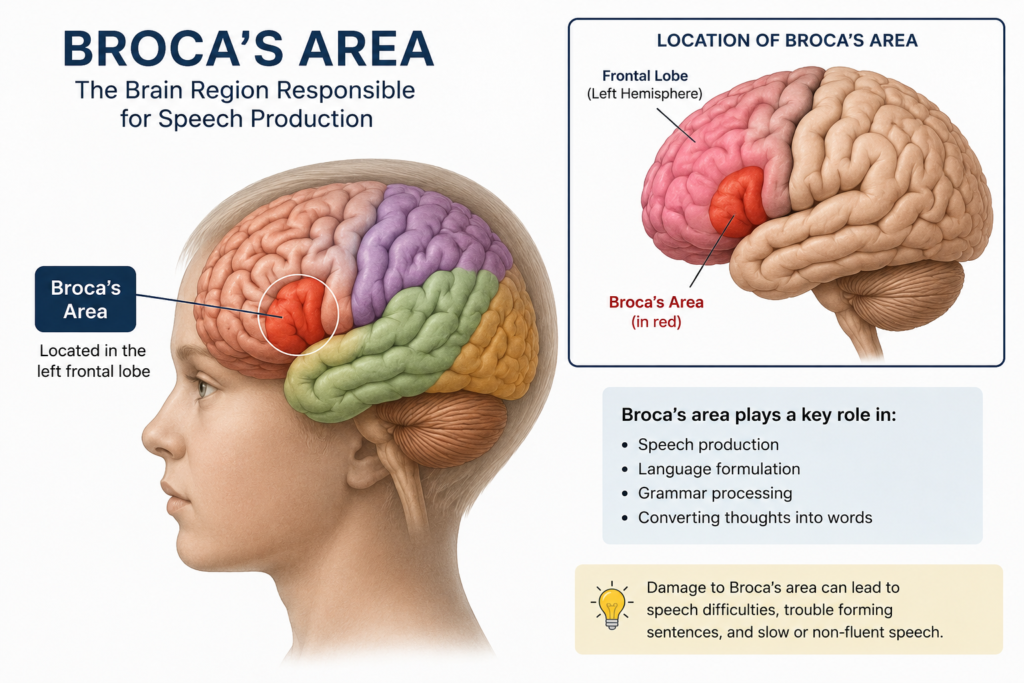
Broca area is located in the frontal lobe of the brain, usually in the left hemisphere. It is responsible for several important aspects of language, including:
- Speech production
- Sentence formation
- Grammar organization
- Motor planning for speech
- Coordinating spoken language
Broca’s area helps transform thoughts into spoken words When this process becomes difficult, a child may know what they want to say but struggle to say it clearly.
Researchers have long connected Broca’s area with expressive language difficulties. Recent neuroscience studies continue to support the idea that autistic individuals may process speech differently because of altered brain activation and connectivity patterns (Lai et al., 2024).
How Broca Area and Autism Are Connected
Autism is not caused by a “broken” speech centre. Instead, studies suggest that language-related brain regions may function differently in autistic individuals.
Research by Baojun Lai and colleagues (2024) found atypical brain lateralisation for speech processing in autistic children using functional near-infrared spectroscopy (fNIRS). Their findings showed that autistic children processed speech sounds differently compared to non-autistic peers.
Similarly, Amparo V. Márquez-García et al. (2023) reported atypical functional connectivity during language processing in autistic children, particularly in regions associated with semantic and pragmatic communication.
These findings help explain why some autistic children:
- Understand language well.
- Have thoughts they want to communicate.
- But struggle with expressive speech.
This difference is commonly seen in autism speech delay.
Autism Speech Delay and Language Processing
Speech delay in autism is often misunderstood. Many people assume delayed speech reflects reduced intelligence or a lack of understanding. However, research suggests this is not true.
A longitudinal study by Kenza Latrèche and colleagues (2024) found that both expressive and receptive language profiles in autistic preschoolers vary significantly across children and develop differently over time.
Recent research also shows that autistic children may process speech sounds differently at the neurological level.
For example, Kirill A. Fadeev et al. (2024) found reduced processing of vowel sounds in the left temporal cortex of autistic children, which affected speech perception in noisy environments.
Another study by Carly Demopoulos et al. (2023) found that differences in rapid auditory processing were associated with verbal communication difficulties in autism.
Together, these studies suggest that communication challenges in autism are deeply connected to how the brain processes sound, language, and speech coordination.
Expressive vs Receptive Language in Autism
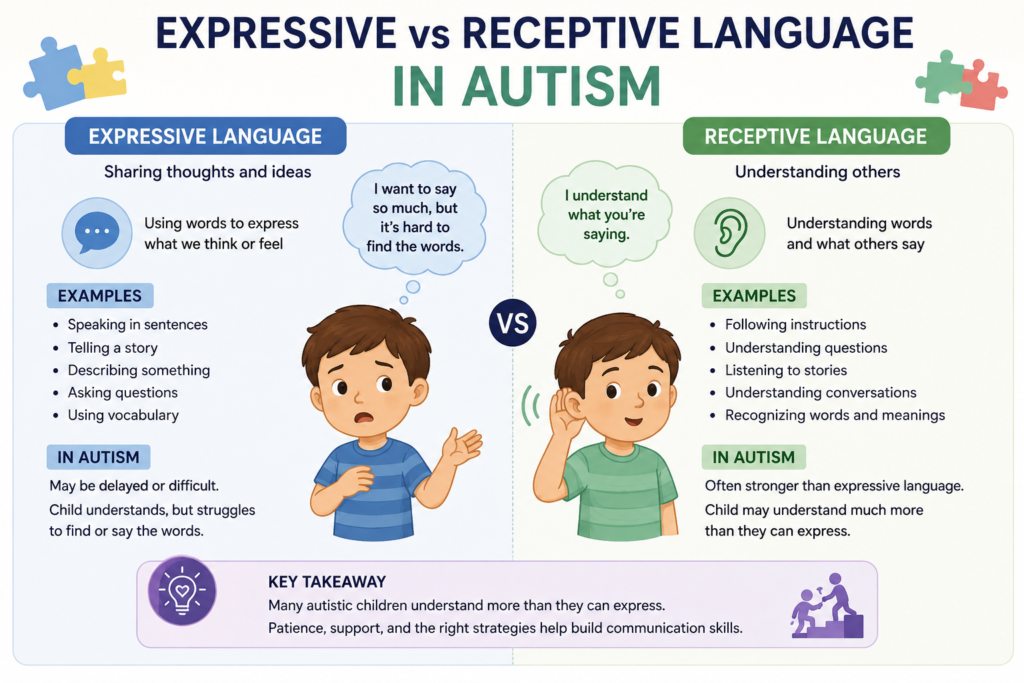
One of the most important concepts for parents is understanding the difference between:
- Receptive language → understanding language
- Expressive language → using language to communicate.
Many autistic children have stronger receptive language than expressive language.
This means a child may:
- Understand instructions
- Recognize conversations
- Know what they want to communicate.
- But still struggle to speak clearly.
Research increasingly supports this uneven language profile in autism (Latrèche et al., 2024).
This explains why some autistic children appear to “understand everything” but have difficulty responding verbally.
Communication Challenges Are Not About Intelligence
Speech difficulties in autism should not be mistaken for low intelligence.
A 2024 report widely discussed in autism research found that many nonspeaking autistic teenagers and adults demonstrated stronger literacy and language understanding abilities than previously assumed.
Researchers are increasingly encouraging professionals and families to separate speech ability from intelligence and cognitive understanding.
This shift is important because many autistic individuals may communicate effectively through:
- Writing
- AAC devices
- Gestures
- Typing
- Visual supports
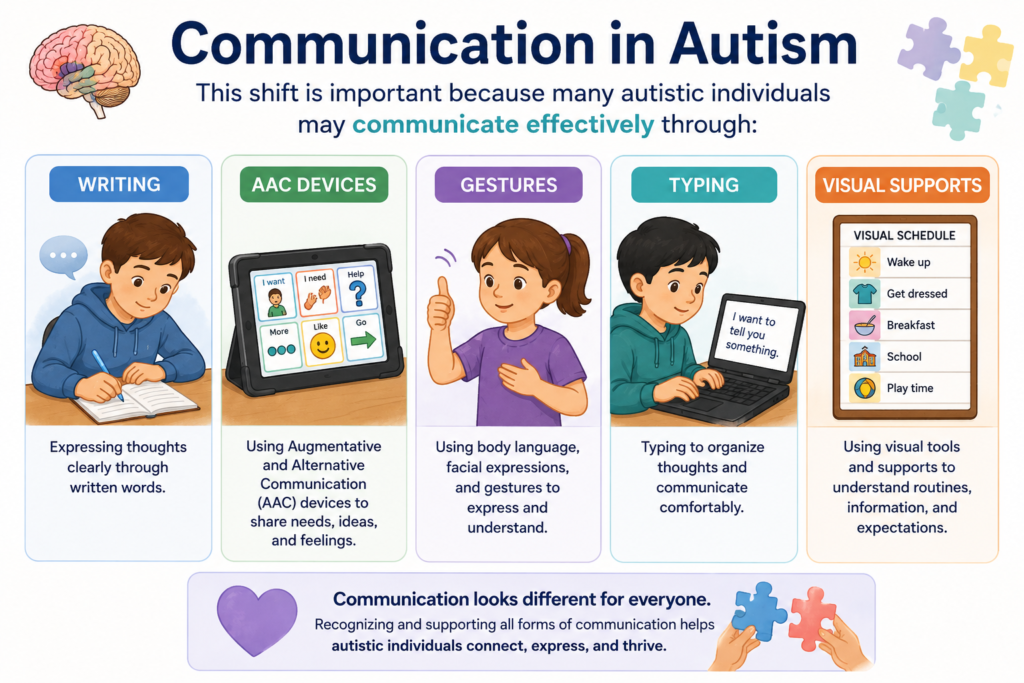
Communication is broader than spoken speech alone.
How to Improve Communication in Autism
Supporting communication in autism should focus on connection rather than pressure.
Give Extra Processing Time
Autistic children may need additional time to organise language and speech responses.
After asking a question:
- Pause
- Wait calmly
- Reduce pressure to respond immediately.
This allows the brain more time to process language.
Model Language Naturally
Instead of constantly correcting speech, model natural language.
For example:
- Child: “Car go.”
- Parent: “Yes, the car is going fast.”
This supports language growth without creating shame.
Use Visual Supports
Visual communication tools can reduce language-processing demands.
Helpful supports include:
- Visual schedules
- Picture cards
- Gestures
- Emotion charts
These tools support understanding and expression.
Accept All Forms of Communication
Many autistic children communicate in non-verbal ways.
This may include:
- Pointing
- Facial expressions
- Typing
- AAC devices
- Written communication
Accepting all forms of communication builds confidence and emotional safety.
Reframing Autism Communication Challenges
Understanding Broca area and autism helps parents see communication differently.
A child who struggles to speak is not:
- Lazy
- Defiant
- Ignoring others
- Refusing to communicate
Their brain may simply process speech and language differently.
Recent studies on speech coordination and minimally speaking autistic individuals continue to support this understanding (Talkar et al., 2024).
When parents shift from correction to connection, communication often becomes safer and more meaningful for the child.
Can Communication Improve in Autism?
Yes. Research shows that the brain remains adaptable throughout development.
With supportive environments and responsive communication approaches:
- Language skills can improve.
- Confidence can grow
- An emotional connection can deepen.
Progress may look different for every child, and communication may not always resemble typical speech. What matters most is that the child feels understood and supported.
Conclusion
Understanding the relationship between Broca area and autism helps families recognise that speech difficulties are often linked to neurological language processing differences rather than unwillingness or lack of intelligence.
Recent research continues to show that autistic communication is complex, meaningful, and deeply connected to how the brain processes language, sound, and social interaction.
When parents replace pressure with patience and understanding, they create an environment where communication can grow naturally and safely.
FAQs About Broca Area and Autism
1. Why does my autistic child understand everything but struggle to speak?
Many autistic children have stronger receptive language (understanding) than expressive language (speaking). Research suggests that differences in Broca’s area and autism may affect speech production and language organisation, making it harder for children to turn thoughts into spoken words (Lai et al., 2024).
2. Is autism speech delay caused by low intelligence?
No. Speech delay in autism is not linked to low intelligence. Many autistic children understand language, emotions, and routines very well but may struggle with verbal expression due to differences in language processing and brain connectivity (Latrèche et al., 2024).
3. Can autistic children develop speech later?
Yes. Many autistic children develop speech gradually over time, especially in supportive and low-pressure environments. Communication progress can continue throughout childhood and adolescence.
4. What is the difference between expressive and receptive language in autism?
- Receptive language refers to understanding words, instructions, and conversations.
- Expressive language refers to using words to communicate thoughts and feelings.
In autism, receptive language is often stronger than expressive language, which explains why some children understand more than they can verbally express.
5. Does Broca’s area only affect speech?
No. Broca’s area also helps with:
- Sentence formation
- Grammar
- Language sequencing
- Speech motor planning
Difficulties in this area may affect overall communication, not just speaking.
6. What are the common signs of autism speech delay?
Some common signs include:
- Delayed first words
- Limited vocabulary
- Difficulty forming sentences
- Echolalia (repeating words or phrases)
- Understanding language better than speaking
- Difficulty answering questions
7. Should parents force speech practice?
Research and autism-informed approaches suggest that pressure-based communication can increase stress. Instead, supportive communication strategies such as modelling language, visual supports, AAC, and giving extra processing time are more effective.
8. Can non-speaking autistic children still communicate effectively?
Yes. Communication is not limited to speech. Many autistic individuals communicate through:
- Gestures
- AAC devices
- Writing or typing
- Facial expressions
- Visual supports
Meaningful communication can happen in many forms.
9. Can communication skills improve in autism?
Yes. The brain is adaptable, and communication skills can improve with supportive environments, therapy, emotional safety, and consistent connection-based communication approaches.
At NeuroNestHub, we aim to support parents with evidence-based guidance and practical resources. Explore more articles on autism, ADHD, and child development on our platform.
References
Demopoulos, C., Skiba, S. A., Kopald, B. E., Bangera, N., Paulson, K., & Lewine, J. D. (2023). Associations between rapid auditory processing of speech sounds and specific verbal communication skills in autism. Frontiers in Psychology, 14. https://doi.org/10.3389/fpsyg.2023.1223250
Fadeev, K. A., Romero Reyes, I. V., Goiaeva, D. E., Obukhova, T. S., & Ovsiannikova, T. M. (2024). Attenuated processing of vowels in the left temporal cortex predicts speech-in-noise perception deficit in children with autism. Journal of Neurodevelopmental Disorders, 16(67). https://doi.org/10.1186/s11689-024-09585-2
Lai, B., Yi, A., Zhang, F., Wang, S., Xin, J., Li, S., & Yu, L. (2024). Atypical brain lateralization for speech processing at the sublexical level in autistic children revealed by fNIRS. Scientific Reports, 14. https://doi.org/10.1038/s41598-024-53128-7
Latrèche, K., Godel, M., Franchini, M., Kojovic, N., & Schaer, M. (2024). Early trajectories and moderators of autistic language profiles: A longitudinal study in preschoolers. Autism. https://doi.org/10.1177/13623613241253015
Márquez-García, A. V., Ng, B. K., Iarocci, G., Moreno, S., Vakorin, V. A., & Doesburg, S. M. (2023). Atypical associations between functional connectivity during pragmatic and semantic language processing and cognitive abilities in children with autism. Brain Sciences, 13(10), 1448. https://doi.org/10.3390/brainsci13101448
Talkar, T., Johnson, K. T., Narain, J., Maes, P., Picard, R., & Quatieri, T. F. (2024). Quantifying speech production coordination from non- and minimally speaking individuals. Journal of Autism and Developmental Disorders. https://doi.org/10.1007/s10803-023-06206-0