
Introduction: Understanding Assistive Technology for Autism and ADHD
Technology is increasingly becoming an important part of inclusive education and everyday life. For individuals with Autism Spectrum Disorder (ASD) and Attention-Deficit/Hyperactivity Disorder (ADHD), the right technological support can make communication, learning, organisation and daily activities more accessible.
Assistive Technology for Autism and ADHD refers to devices, software, applications and other tools designed to help individuals overcome specific barriers and participate more independently in everyday activities.
However, assistive technology is not limited to sophisticated electronic devices. A visual timetable, a digital reminder, a communication application or a text-to-speech programme can all serve as assistive tools.
It is important to recognise that autism and ADHD are different neurodevelopmental conditions, and individuals within each group have diverse strengths and support requirements. Consequently, a tool that works well for one person may not be useful for another.
Research increasingly highlights technology’s potential to improve accessibility, communication, and functional participation. The objective should not be to make neurodivergent individuals conform to conventional expectations but to provide tools that support their individual needs.
Why Is Assistive Technology for Autism and ADHD Important?
Autistic individuals may experience differences in communication, sensory processing, social interaction and flexibility. Some may benefit from additional communication methods, predictable routines or visual information.
Individuals with ADHD may experience difficulties with attention regulation, working memory, time management, task initiation and organisation. These challenges can affect academic performance, workplace responsibilities and everyday routines.
Assistive technology can provide external support for some of these difficulties.
For example:
- A communication device can help someone express needs and preferences.
- A visual schedule can make daily routines more predictable.
- A digital reminder can help someone remember appointments or assignments.
- Speech-to-text software can reduce the demands of writing.
- A task-management application can break complex activities into manageable steps.
Klavina et al. (2024), in a systematic review of 18 studies, identified potential benefits of assistive technology in promoting daily living skills, social participation and independence among individuals with autism and/or intellectual disabilities.
These findings highlight how technology can support participation beyond the classroom.
Types of Assistive Technology for Autism and ADHD
Different tools address different functional needs. The following categories provide an overview of commonly used assistive technologies.
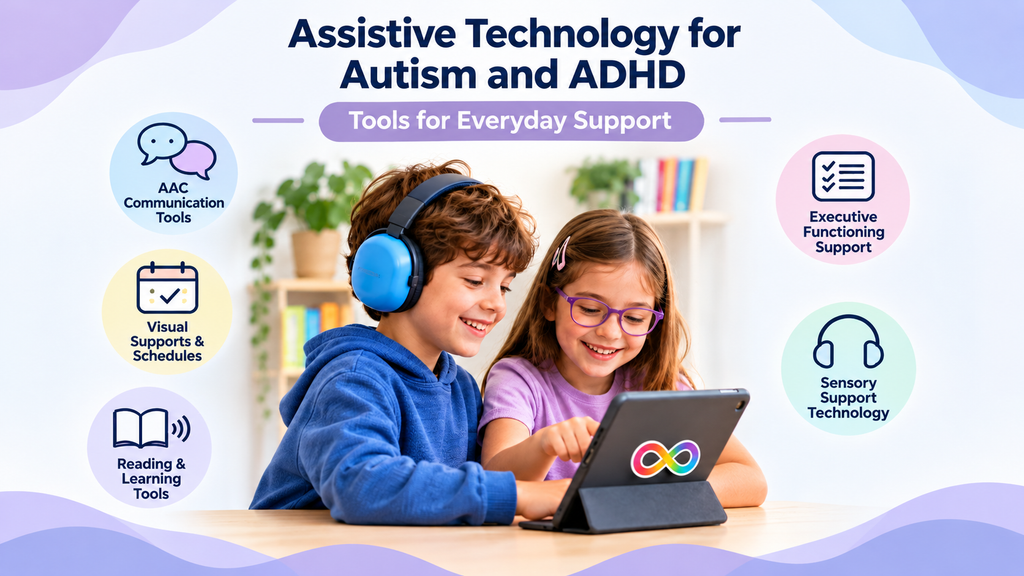
1. Assistive Technology for Autism and ADHD: Communication and AAC Tools
Augmentative and Alternative Communication (AAC) includes methods and tools that supplement or provide alternatives to spoken communication.
AAC may include:
- Picture-based communication systems.
- Communication boards.
- Speech-generating devices.
- Tablet-based communication applications.
- Text-based communication tools.
For autistic individuals who are nonspeaking, minimally speaking, or who have difficulty communicating verbally in particular situations, AAC can provide alternative ways to express thoughts, choices, needs, and emotions.
Muharib et al. (2024) conducted a meta-analysis examining tablet-based speech-generating devices for individuals with autism. Their research evaluated the effects of these devices on communication skills and highlighted their potential as an intervention option.
More recently, Therrien et al. (2025) reviewed 20 studies involving speech-generating devices for autistic preschoolers. Eleven studies demonstrated moderate-to-strong effects, although the researchers also identified limitations in how communication outcomes and real-world relevance were measured.
An important consideration is that AAC should not be viewed as a replacement for speech development. It provides an additional means of communication and should be individualised according to the person’s communication preferences and abilities.
2. Visual Supports and Digital Schedules
Visual supports are particularly useful when individuals benefit from information presented through pictures, symbols, written instructions or predictable sequences.
Examples include:
- Visual daily schedules.
- First-then boards.
- Picture-based instructions.
- Digital calendars.
- Visual countdown timers.
- Step-by-step task sequences.
Rutherford et al. (2020), in a scoping review examining visual supports at home and in community settings, identified their potential to improve predictability, communication, and participation and to reduce anxiety among autistic individuals.
For example, a child who finds transitions difficult may benefit from a visual schedule showing the sequence of morning activities: waking up, brushing teeth, getting dressed, eating breakfast and leaving for school.
For individuals with ADHD, visual task lists and countdown timers may help make time and task expectations more concrete.
These tools can also be used without expensive devices. Printed schedules, picture cards and simple timers are accessible alternatives.
3. ADHD Assistive Tools for Organisation and Executive Functioning
Executive functioning involves mental processes that support planning, organisation, working memory, self-monitoring and goal-directed behaviour.
Some individuals with ADHD experience difficulties with these processes, making everyday activities challenging.
Useful ADHD assistive tools include:
- Digital calendars and scheduling applications.
- Task-management applications.
- Automated reminders and alarms.
- Focus timers and time-tracking tools.
- Digital note-taking applications.
- Speech-to-text and text-to-speech software.
Wong et al. (2023) conducted a systematic review and meta-analysis of 19 randomised controlled studies involving 1,843 school-age children with ADHD.
The researchers found small but statistically significant improvements in certain outcomes, including computer-rated inattention and parent-rated executive functioning. However, the quality of the included studies was generally low to moderate, indicating the need for stronger research.
These findings suggest that technology-based interventions may support selected cognitive and behavioural outcomes, but they should not be interpreted as evidence that every productivity application improves ADHD symptoms.
For example, a student may use a digital planner to divide a school assignment into smaller tasks, set individual deadlines and receive reminders. This can provide external structure when remembering multiple instructions becomes difficult.
4. Reading, Writing and Learning Technologies
Learning-related assistive technology can reduce barriers associated with reading, writing and information processing.
Some commonly used options include:
- Text-to-speech software, which reads digital text aloud.
- Speech-to-text software, which converts spoken words into written text.
- Audiobooks and digital reading platforms.
- Spelling and grammar support tools.
- Digital annotation and note-taking applications.
- Screen readers and accessible learning platforms.
For an autistic learner, listening to instructions while following written information may make certain learning tasks more accessible.
For a student with ADHD, speech-to-text tools may reduce the effort involved in writing and help capture ideas before they are forgotten.
The important consideration is to identify the specific learning barrier rather than assuming that every individual with autism or ADHD requires the same technology.
5. Sensory and Environmental Support Technology
Some autistic individuals experience differences in sensory processing, while some individuals with ADHD benefit from managing environmental distractions.
Technology-based options may include:
- Noise-reducing headphones.
- Adjustable lighting systems.
- Personalised sound environments.
- Digital sensory activities.
- Wearable reminders and discreet alerts.
These tools may help individuals manage particular environmental demands.
However, sensory preferences are highly individual. Noise-reducing headphones, for example, may be helpful in a noisy environment but may not be comfortable or appropriate for everyone.
What Does Research Say About Assistive Technology for Autism and ADHD?
The research literature is encouraging, but it is important to interpret the evidence carefully.
Klavina et al. (2024) identified positive outcomes related to independence, daily living skills and social participation in their review of assistive technology studies involving individuals with autism and/or intellectual disabilities.
Similarly, Wong et al. (2023) found measurable improvements in selected attention and executive functioning outcomes following technology-based interventions for children with ADHD.
Bettencourt et al. (2024), in a systematic meta-review of information and communication technologies for neurodevelopmental disorders, also highlighted limitations in the overall quality of existing research.
Together, these findings suggest that assistive technology has considerable potential, but its effectiveness depends on the individual, the purpose of the tool, implementation and the quality of supporting evidence.
Technology should therefore be viewed as an enabling support rather than a universal solution.
How to Choose the Right Assistive Technology for Autism and ADHD
Selecting appropriate technology requires understanding the individual’s needs, preferences and everyday challenges.
Consider the following steps:
1. Identify the specific need: Is the individual experiencing communication barriers, difficulty following routines, reading challenges or problems with time management?
2. Involve the individual: Wherever possible, include the person’s preferences and choices in selecting the tool.
3. Start with simple solutions: A printed visual schedule or basic reminder application may be sufficient before investing in expensive equipment.
4. Consider accessibility: Evaluate cost, language options, ease of use, device compatibility and availability of support.
5. Monitor its usefulness: Observe whether the tool improves participation, independence or task completion in real-life settings.
6. Review regularly: Needs can change with age, educational expectations, employment and everyday circumstances.
Parents, educators, occupational therapists, speech-language professionals and other relevant specialists can collaborate to identify suitable options.
Challenges and Limitations of Assistive Technology for Autism and ADHD
Despite its potential, assistive technology also presents challenges.
The cost of specialised devices, limited digital accessibility, inadequate training and inconsistent implementation can restrict access. Excessive notifications, complicated interfaces and poorly selected applications may also create additional demands.
Privacy and data security are important considerations, particularly when applications collect children’s personal information or communication data.
Furthermore, technology should not become a substitute for human interaction, appropriate educational accommodations or individualised professional support.
Not every individual needs a digital solution. Sometimes, a low-cost visual aid or a simple environmental adjustment may be more effective.
Conclusion: Assistive Technology for Autism and ADHD as a Tool for Inclusion
Assistive technology can create meaningful opportunities for individuals with autism and ADHD by supporting communication, learning, organisation, sensory needs and everyday independence.
Research by Klavina et al. (2024), Wong et al. (2023) and Therrien et al. (2025) demonstrates encouraging developments across different areas of assistive technology, while also highlighting the need for further research.
Ultimately, the value of technology should be measured not by how advanced a device is, but by how meaningfully it supports an individual’s life.
The most effective approach is person-centred, accessible and flexible. Technology should adapt to the individual, rather than expecting the individual to adapt to technology.
Understanding the Evidence: It is important to recognise that scientific evidence varies across different assistive technologies. While some tools, such as AAC devices and visual supports, have been examined in research studies, others, including digital planners and reminder applications, are primarily practical aids. Their usefulness may differ from person to person, and they should not be considered clinically validated interventions for autism or ADHD without supporting research.
At NeuroNestHub, we believe that inclusion begins with understanding individual differences and creating environments where every person has the opportunity to communicate, learn and participate in their own way.
Discover real stories, practical resources, and a growing community at NeuroNestHub. If you have a story to share, we’d love to hear from you: https://neuronesthub.com/
References
Bettencourt, C., Anzalone, S., Chetouani, M., Cohen, D., & Grossard, C. (2024). Have information and communication technologies research for neurodevelopmental disorders improved overtime? A systematic meta-review. Research in Autism Spectrum Disorders, 118, 102483. https://doi.org/10.1016/j.rasd.2024.102483
Klavina, A., Pérez-Fuster, P., Daems, J., Lyhne, C. N., Dervishi, E., Pajalic, Z., Øderud, T., Fuglerud, K. S., Markovska-Simoska, S., Przybyla, T., Klichowski, M., Stiglic, G., Laganovska, E., Alarcão, S. M., Tkaczyk, A. H., & Sousa, C. (2024). The use of assistive technology to promote practical skills in persons with autism spectrum disorder and intellectual disabilities: A systematic review. Digital Health, 10. https://doi.org/10.1177/20552076241281260
Muharib, R., Walker, V., & Dunn, W. (2024). Effects of interventions involving tablet-based speech-generating devices for individuals with ASD: A meta-analysis. Journal of Autism and Developmental Disorders, 54(12), 4496–4514. https://doi.org/10.1007/s10803-023-06173-6
Rutherford, M., Baxter, J., Grayson, Z., Johnston, L., & O’Hare, A. (2020). Visual supports at home and in the community for individuals with autism spectrum disorders: A scoping review. Autism, 24(2), 447–469. https://doi.org/10.1177/1362361319871756
Therrien, M. C. S., Whalon, K., Nunes, D., Marti, P., & Sellers, A. (2025). A systematic review of AAC interventions using speech-generating devices for autistic preschoolers. Augmentative and Alternative Communication, 41(2), 114–128. https://doi.org/10.1080/07434618.2025.2479768
Wong, K. P., Qin, J., Xie, Y. J., & Zhang, B. (2023). Effectiveness of technology-based interventions for school-age children with attention-deficit/hyperactivity disorder: Systematic review and meta-analysis of randomized controlled trials. JMIR Mental Health, 10, e51459. https://doi.org/10.2196/51459