
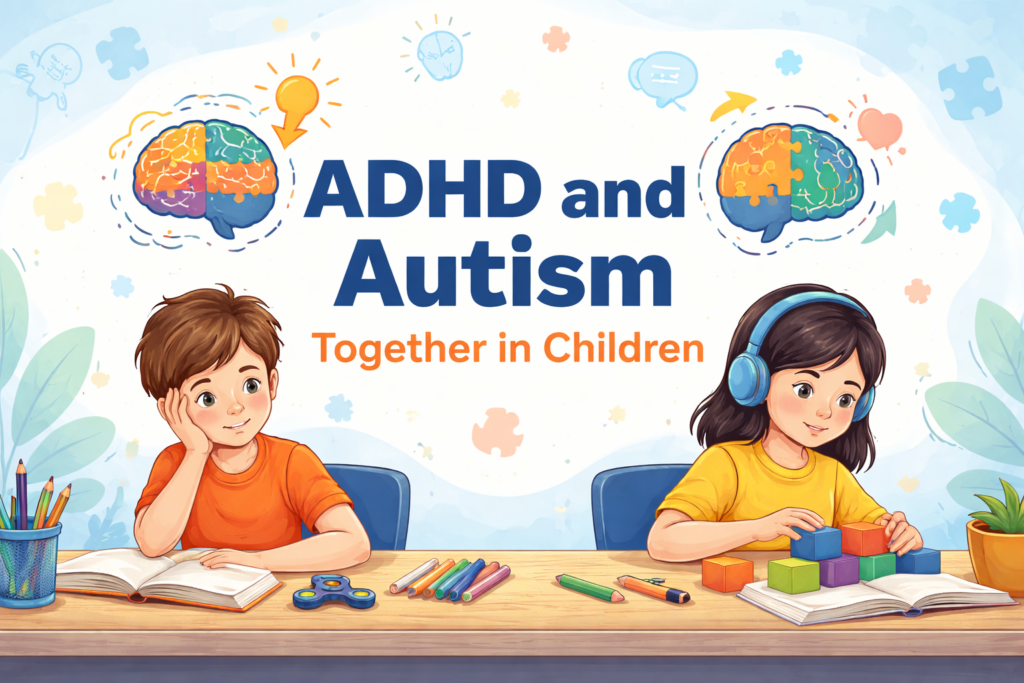
Introduction
“Many parents in India often wonder whether ADHD and Autism together can exist in the same child.”
A question that many parents quietly carry but rarely voice openly is finally being discussed more openly today.
For years, this question did not have a clear answer in clinical practice. Parents were often told it was either one condition or the other. However, advances in research and changes in diagnostic frameworks have reshaped this understanding.
Today, the answer is clear: yes, a child can have both Attention-Deficit/Hyperactivity Disorder (ADHD) and Autism Spectrum Disorder (ASD).
This co-occurrence, often referred to as a dual diagnosis, is more common than previously believed. Yet, in India, awareness around this overlap is still evolving. While conversations about neurodiversity are increasing, early identification and accurate diagnosis remain inconsistent, especially outside urban centres.
Understanding this intersection is not just a clinical necessity; it is essential for providing the right support at the right time.
Understanding ADHD and Autism
Before exploring how these conditions overlap, it is important to understand them individually.
ADHD: More Than Just “Hyperactivity”

ADHD is a neurodevelopmental condition primarily associated with:
- Difficulty sustaining attention
- Impulsivity (acting without thinking)
- Hyperactivity (excessive movement or restlessness)
In Indian classrooms, children with ADHD are often labelled as “distracted,” “naughty,” or “unable to sit still.” However, these behaviours are rooted in differences in brain functioning, particularly in attention regulation and executive functioning.
Many children show early signs of inattention and hyperactivity, which are often explained in detail in our guide on ADHD symptoms in children.
Autism: A Spectrum of Differences

Autism Spectrum Disorder is characterised by:
- Differences in social communication and interaction
- Restricted or repetitive patterns of behaviour
- Sensory sensitivities (to sound, touch, light, etc.)
Autism exists on a spectrum, meaning each child presents differently. Some children may have strong language skills but struggle socially, while others may have significant communication challenges.
Similarly, early indicators like social communication differences are discussed in our article on early signs of autism in children.
Can ADHD and Autism Together Occur in Children?
Yes, research now confirms that ADHD and Autism together are not only possible but increasingly recognised. This understanding has become clearer since the introduction of updated diagnostic guidelines.
Earlier diagnostic systems did not allow clinicians to diagnose ADHD and autism together. This often led to incomplete or misleading diagnoses. However, with the DSM-5 (Diagnostic and Statistical Manual of Mental Disorders, Fifth Edition), clinicians can now formally identify both conditions in the same child.
What Research Tells Us
Recent studies highlight that this overlap is not rare:
- 30–50% of children with autism also show symptoms of ADHD (Casseus et al., 2023)
- Around 10% of children with ADHD may meet criteria for autism (Canals et al., 2024)
- ADHD is one of the most common co-occurring conditions in autism (Al Ghamdi & AlMusailhi, 2024)
This means many children are not dealing with a single diagnosis but rather a combined neurodevelopmental profile.
Why Do ADHD and Autism Overlap?
The co-occurrence of ADHD and autism is not coincidental. Several underlying factors contribute to this overlap:
1. Shared Brain Mechanisms
Both ADHD and autism involve differences in brain development, particularly in areas related to:
- Executive functioning
- Attention control
- Sensory processing
These shared neurological pathways can lead to overlapping behaviours.
2. Genetic Influences
Research increasingly points to common genetic factors that contribute to both conditions. Families may notice traits of attention challenges, social differences, or sensory sensitivities across generations.
3. Symptom Interaction
Some behaviours can appear similar in both conditions:
- Difficulty focusing
- Challenges in social settings
- Emotional regulation issues
Because of this, one condition may mask or overshadow the other, leading to partial or delayed diagnosis.
How Dual Diagnosis May Present in a Child
A child with both ADHD and autism may display a mix of characteristics from both conditions. For example:
- Difficulty sitting still or sustaining attention (ADHD)
- Challenges in understanding social cues (autism)
- Impulsive actions or frequent interruptions (ADHD)
- Repetitive movements or insistence on routines (autism)
- Strong sensory sensitivities (autism)
In many Indian households and schools, these behaviours are often misunderstood. They may be attributed to:
- “Stubbornness”
- “Lack of discipline”
- “Poor parenting”
Such interpretations not only delay professional assessment but also increase stress for both the child and the family.
Understanding ADHD and Autism Together in the Indian Context

Many families in India face challenges when it comes to identifying ADHD and autism together. Despite growing awareness, gaps still exist in early screening, diagnosis, and access to support systems.
Where the Gap Lies
1. Delayed Identification
Early screening is not yet a standardised practice across the country. Many children are identified only when academic or behavioural challenges become severe.
2. Misinterpretation of Symptoms
In children with autism, ADHD symptoms are often overlooked. Hyperactivity or impulsivity may be dismissed as behavioural issues rather than recognised as part of a co-occurring condition.
3. Limited Access to Specialists
Comprehensive assessments require a multidisciplinary approach involving psychologists, paediatricians, occupational therapists, and educators. Such services are still concentrated in urban areas, making access difficult for many families.
A recent Indian systematic review (Mishra et al., 2024) highlights that ADHD continues to be under-recognised, even in relatively aware populations, suggesting that dual diagnosis may be even more frequently missed.
Why Early and Accurate Diagnosis Matters
Identifying ADHD and Autism together early can make a significant difference in a child’s developmental journey.
Benefits of Early Diagnosis
- Targeted intervention planning
- Better academic accommodations
- Improved behavioural understanding
- Reduced frustration for parents and caregivers
- Stronger long-term developmental outcomes
When only one condition is identified, interventions may not fully address the child’s needs. For example, strategies designed for autism alone may not effectively manage ADHD-related impulsivity.
This can lead to:
- Ineffective support
- Increased behavioural challenges
- Emotional distress for the child
Intervention: What Works Best?
Children with both ADHD and autism benefit most from integrated, individualised approaches rather than one-size-fits-all solutions.
Key Intervention Strategies
1. Behavioural Therapy
Behavioural therapy for children helps improve attention, reduce impulsivity, and build adaptive behaviours.
2. Parent Training Programs
Empower parents with practical strategies to support their child at home.
3. Occupational Therapy
Addresses sensory sensitivities and helps with self-regulation skills.
4. Structured Classroom Support
Includes visual schedules, predictable routines, and individualised learning strategies.
5. Medication (When Required)
In some cases, medication may be prescribed to manage ADHD symptoms, improving focus and reducing hyperactivity.
Research consistently emphasises that multimodal interventions-combining therapies, educational strategies, and family support- are the most effective (Al Ghamdi & AlMusailhi, 2024).
A Balanced Reality in India
India is at an important transition point in its approach to neurodevelopmental conditions.
What Is Improving
- Growing awareness of neurodiversity
- Increased conversations around ADHD and autism
- Policy-level focus on inclusive education policies in India
- Rising parent-led advocacy and support communities
What Still Needs Attention
- Mandatory early screening systems
- Teacher training and access to resources for inclusive education in India
- Affordable and accessible diagnostic services
- Greater integration of multidisciplinary care
The gap is not just medical-it is also educational and societal.
Moving Beyond Labels
One of the most important shifts needed is moving away from rigid labels toward understanding the whole child.
A dual diagnosis is not simply the sum of two conditions. Each child has a unique profile of strengths and challenges. Some individuals may excel in creativity, memory, or problem-solving, while requiring support in areas such as attention or social communication.
Recognising this individuality allows for:
- More meaningful interventions
- Better educational planning
- Greater acceptance and inclusion
Conclusion
A child can absolutely have both ADHD and Autism together, and this overlap is far more common than many assume.
In the Indian context, recognising dual diagnosis is not just a clinical responsibility but a broader social and educational priority. Delayed or incomplete understanding can limit a child’s potential, while early and accurate identification can open the door to the right support systems.
The focus should not be on choosing between labels, but on understanding the child’s complete developmental profile.
Because when we shift from “What is the diagnosis?” to “What does this child need?”, we move closer to truly inclusive and effective support.
For more articles and upcoming resources, visit our homepage https://neuronesthub.com/ at NeuroNestHub.
References
Al Ghamdi, K., & AlMusailhi, J. (2024). Attention-deficit hyperactivity disorder and autism spectrum disorder: Towards better diagnosis and management. Medical Archives, 78(2), 159–163.
Canals, J., Morales-Hidalgo, P., Voltas, N., & Hernández-Martínez, C. (2024). Prevalence of comorbidity of autism and ADHD in the school population: EPINED study. Autism Research, 17(6), 1276–1286.
Casseus, M., Kim, W. J., & Horton, D. B. (2023). Prevalence and treatment of co-occurring autism spectrum disorder and ADHD. Autism Research, 16(4), 855–867.
Mishra, S., Chaudhary, V., Saraswathy, K. N., Shekhawat, L. S., & Devi, N. K. (2024). Prevalence of ADHD in India: A systematic review. Social Psychiatry and Psychiatric Epidemiology.
Zhong, Q., & Porter, M. (2024). Autism spectrum disorder symptoms in individuals with ADHD: A systematic review. Review Journal of Autism and Developmental Disorders.