
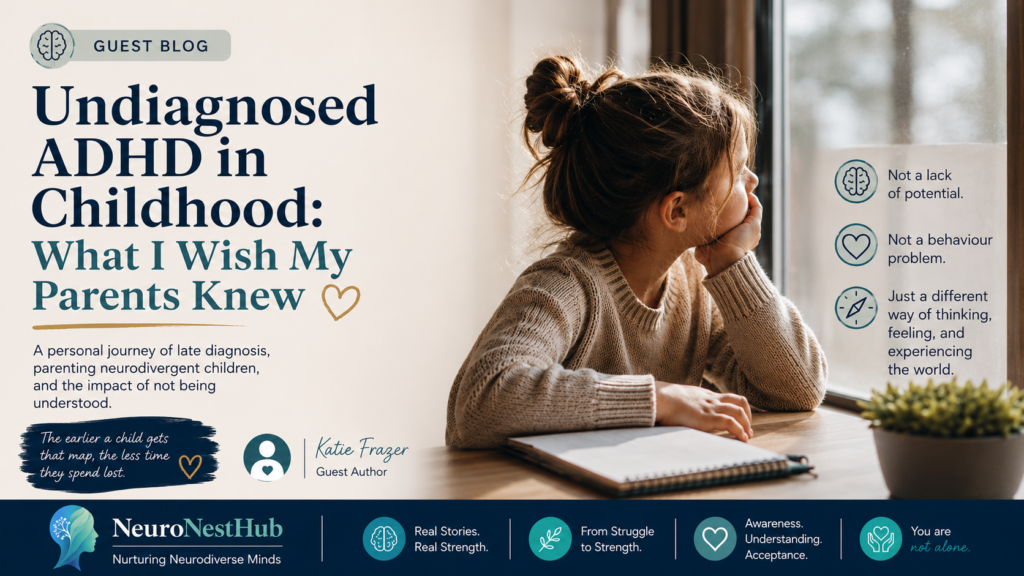
By Katie Frazer | ADHD Specialist Coach | Katie Frazer Coaching
Undiagnosed ADHD in Childhood often goes unnoticed for years, especially in girls, high-achieving, and emotionally sensitive children. Many adults spend years wondering why everyday tasks feel harder than they seem for everyone else, often without realising that ADHD may be part of the picture. In this guest blog, ADHD Specialist Coach and Royal Navy veteran Katie Frazer shares her experience of late ADHD diagnosis, parenting neurodivergent children, and the emotional impact of growing up without understanding why certain struggles felt so heavy.
About the Guest Author
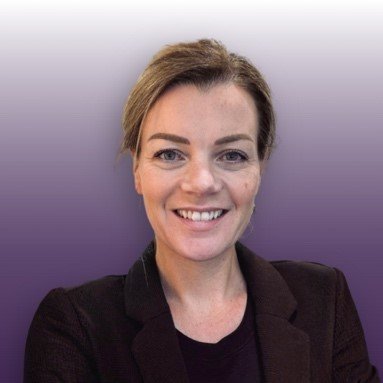
Katie Frazer is a UK and Australia-based ICF-accredited ADHD Specialist Coach, Royal Navy veteran, senior aviation leader, late-diagnosed ADHDer, and parent of neurodivergent children. Through Katie Frazer Coaching, she works one-on-one with late-diagnosed and self-identifying neurodivergent leaders who navigate demanding, high-pressure environments. Her work combines professional coaching, lived experience, and a deep belief that understanding your brain changes everything.
NeuronestHub is deeply thankful to Katie Frazer for contributing her expertise and lived experience to this piece and for supporting greater awareness around neurodivergence in leadership and high-performance spaces.
Guest Blog by Katie Frazer
I was diagnosed with ADHD in my late forties.
By that point, I had served as a Helicopter Engineer and Air Traffic Control Officer in the Royal Navy, led complex operational teams in senior civil aviation roles, raised three children, two of whom are also neurodivergent, and spent the better part of five decades wondering why certain things that seemed effortless for everyone around me felt, for me, like wading through treacle.
When the diagnosis came, I wasn’t devastated. I was relieved.
Not because anything was broken. But because after nearly five decades of not fully understanding myself, I finally had an answer.
There were signs throughout my childhood: talks a lot, needs to pay attention more in class, has lots of potential, etc. Yet nobody saw them for what they were, not because they didn’t care, but because nobody had the language or the awareness to recognise what they were looking at, especially in the UK during the 1980s.
This piece is for the parents who might be in that position now.
What Undiagnosed ADHD Often Looks Like in Children
ADHD doesn’t always look the way people imagine it: a restless boy, unable to sit still, bouncing off classroom walls. That image has dominated our understanding for decades, and it has left millions of children unidentified, undiagnosed, and unsupported as a result.
For many children, and particularly for girls and high-achievers, ADHD is quieter, more internal, and far easier to miss:
- It might look like a child who is bright, articulate, and capable but consistently loses things, forgets instructions, or starts projects with enormous enthusiasm, only to abandon them just as quickly.
- It might look like a child who is daydreaming constantly, not disengaged, but lost inside their own rich, vivid, endlessly interesting inner world. A child who can focus for hours on the things that fascinate them and cannot focus at all on the things that don’t.
- It might look like a child who is working twice as hard as their classmates just to keep up, and nobody notices because the results look the same.
- It might look like a child who is deeply sensitive, emotionally reactive, and easily overwhelmed by things that other children seem to brush off. A child who cries more than expected or explodes suddenly and then, minutes later, seems to have forgotten it entirely.
I am a combination of the last two. Capable enough to compensate. Smart enough to mask. And quietly, privately exhausted by it, long before I had any idea why.
“The earlier a child gets that map, the less time they spend lost.”
Why It Goes Unnoticed, Especially in Girls and High-Achievers
The diagnostic criteria for ADHD were designed around the presentation most commonly observed in young boys: hyperactive, impulsive, and disruptive. The kind of behaviour that makes itself known in a classroom, that teachers flag, that parents cannot miss. This was my son, and the hyperactivity also hid his autism.
Girls, and many boys too, often present very differently. Their hyperactivity is internalised. They develop sophisticated coping strategies. And with girls often socialised to be quiet and more compliant, many traits remain hidden.
High-achieving or high-masking children face a particular invisibility. When a child is performing well academically or appears compliant in the classroom, it is difficult for teachers, parents, or professionals to look beyond those results and ask what it is costing that child to maintain them.
Compounding this, ADHD traits need to be persistent and cause impairment across multiple areas of life before diagnosis is considered. This becomes especially challenging when a child masks at school but emotionally unravels once they get home.
A child who is disorganised may be seen as careless. A child who is emotionally reactive may be viewed as difficult, undisciplined, or defiant. A child who struggles to finish tasks may be described as lacking motivation or focus.
Many parents in high-achieving families, and in communities where academic success carries deep cultural significance, may find it easier to overlook ADHD traits if school reports describe the child as compliant and capable.
The Cost of Not Knowing
When a child watches their peers manage tasks easily that they themselves struggle with, staying organised, maintaining focus, regulating emotions, and following through on tasks, they almost always create their own explanation.
That explanation is usually some version of:
There is something wrong with me. I am lazy. I am not trying hard enough. I am not very clever. I am a disappointment.
We repeat these internal narratives, and they shape the adults we become. They shape our confidence, our relationships, and our ability to trust our own judgement.
I carried versions of these stories well into adulthood, long after I had built a career that, from the outside, looked entirely successful. The gap between how capable I knew I was and how much certain things still cost me was one I could never quite explain until I could.
I had anxiety, struggled to regulate my emotions, and couldn’t understand why I found things difficult that supposedly “should” be easy, while simultaneously being able to handle an aviation emergency standing on my head. None of it made sense, and for a long time, I felt lost.
Understanding changes everything. Not because it fixes anything, but because it replaces blame with clarity. And that clarity is something every child deserves as early as possible.
On Labels, Stigma, and What a Diagnosis Actually Is
For many parents, the idea of a child receiving a diagnosis carries fears that go far beyond a clinical conversation. There are concerns about labels, about limitation, and about what others might think, family members, schools, or the wider community. These were fears I carried too.
In communities where achievement is closely tied to family pride and social standing, these concerns can become even heavier. A child who is perceived as “struggling” or “different” may feel like a reflection on the family itself. The instinct to push through difficulties quietly is deeply understandable.
But what I have come to understand, both through my own life and through the coaching work I do with adults who are only now making sense of their childhood experiences, is this:
A diagnosis does not limit a child. It gives them a map.
It allows them to understand how their brain works, plan accordingly, and navigate life in ways that support them rather than exhaust them.
The earlier a child receives that understanding, the less shame they accumulate. The more energy they have available for the things they are genuinely extraordinary at, because ADHD brains, when understood and supported rather than blamed and corrected, are often extraordinary in many ways.
My Son’s Story
My son is now 13. He was diagnosed at seven years old with Autism and ADHD Combined Type.
I knew there was something different about him almost from birth, but at that time, I had a very limited understanding of neurodivergence. I didn’t have the language for what I was seeing, and I trusted the medical and childcare professionals around us.
As he grew, I repeatedly asked:
“Do you think there is anything wrong with him?”
I was consistently told:
“No, you’re just not used to normal boys because your eldest boy is so quiet.”
He was treated like a naughty child and placed on the “naughty table” at the front of the classroom.
Three years ago, at the age of 10, he was also diagnosed with Generalised Anxiety Disorder.
That diagnosis matters deeply to me because, as a toddler and preschooler, he was joyful, confident, energetic, and full of life. Years later, he became overwhelmed by anxiety.
I was ignored as his parent and dismissed when I raised concerns. All he wanted was to do the right thing, yet he couldn’t understand why nobody seemed to recognise that.
A child whose ADHD traits were so visible was still reduced to being seen as “naughty.”
School after school attempted to mould him into a system that was never designed for the way his brain worked.
The impact of that has been low self-esteem, anxiety, and emotional exhaustion.
Recently, he said something to me that I will never forget:
“Mummy, I have lost my sparkle.”
What You Can Do
I want to be clear that I am not a clinician, and this is not medical advice. If you are concerned about your child, the most important step is to speak with a qualified professional who can carry out an appropriate assessment.
But as a coach who works with adults navigating late diagnosis, and as a parent of neurodivergent children, there are a few things I would gently offer:
Trust What You Are Observing
Parents often sense that something is different long before anyone else names it. That instinct is worth exploring, not dismissing.
Look Beyond Behaviour
A child who is reactive, avoidant, or inconsistent is not necessarily a child who needs more discipline. There may be a child whose nervous system is working extremely hard with very little support.
Sometimes, emotional reassurance, safety, and connection can help a child regulate more effectively than immediate correction.
Separate the Child From the Struggle
The difficulties are not character flaws. They are the shape of a brain that works differently, and that difference, when understood and supported, is rarely a limitation.
Ask for Help Early
Seeking professional guidance or an assessment is not an admission of failure. It is one of the most supportive and proactive things a parent can do.
What Adults Wish They Had Known Earlier
The adults I work with who were diagnosed later in life almost universally say some version of the same thing:
“I wish I had known sooner.”
Not because life would have been free from challenges, but because they would have understood themselves earlier. They would have been kinder to themselves. They would not have spent so many years believing they were the problem.
Your child deserves the chance to understand themselves. The earlier that journey begins, the better equipped they will be for everything that follows.
Connect with Katie Frazer
If Katie’s story and insights resonated with you, you can learn more about her work and connect with her through her coaching platform and social channels. Visit Katie Frazer Coaching, connect with her on LinkedIn, or follow her on Instagram for more insights and updates.
This article was contributed to NeuroNestHub as part of our community voices and guest contributor initiative, where lived experiences, professional insights, and diverse perspectives come together to foster awareness, empathy, and meaningful conversations around neurodiversity, mental health, and inclusive leadership.
Discover real stories, practical resources, and a growing community at NeuroNestHub, and if you have a story to share, we’d love to hear from you: https://neuronesthub.com/
Disclaimer: This guest blog is based on lived experience, professional coaching insights, and personal perspectives shared for awareness and educational purposes only.