
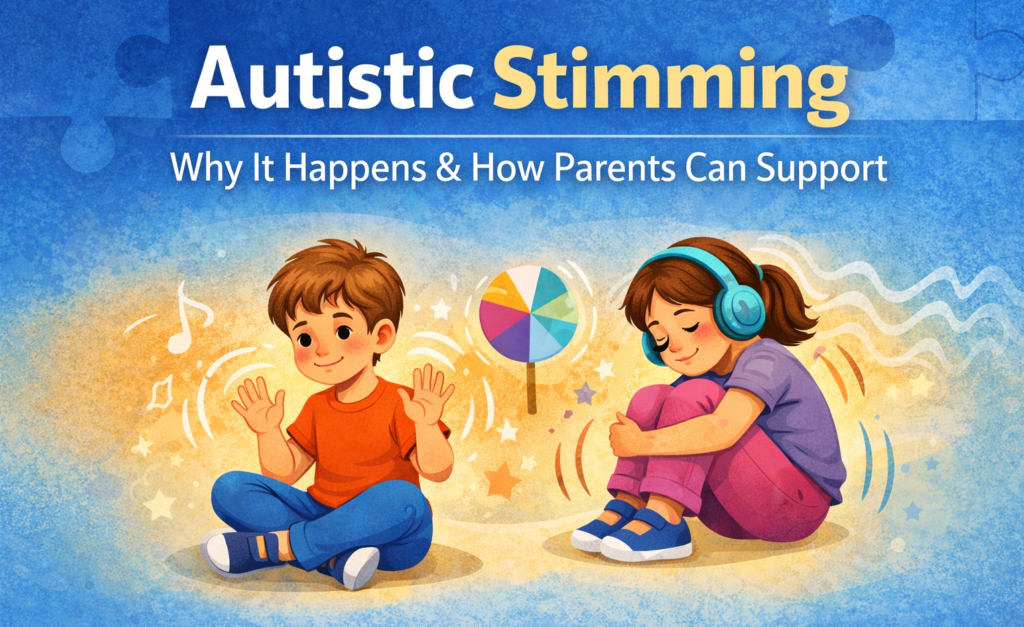
Understanding the Purpose, Practice, and Support of Stimming in Autistic Children and Adults
Abstract
Autistic stimming, also known as self-stimulatory behaviour is a prevalent characteristic of autism spectrum disorder (ASD). While historically stigmatised, recent research suggests that stimming often supports sensory regulation, emotional self-soothing, and communication. This article reviews empirical findings from the past 5-6 years, explaining why stimming occurs, its benefits for autistic individuals, and how caregivers can respond with empathy and evidence-based strategies.
Introduction
Autistic stimming refers to repetitive movements, sounds, or actions used by many individuals with autism to regulate sensory experiences and connect with their environment. It is recognized as a core feature in the Diagnostic and Statistical Manual of Mental Disorders (DSM-5) and plays an important role in sensory and emotional experiences for autistic individuals. Stimming may include hand-flapping, rocking, humming, or repeating phrases, all of which serve varied purposes depending on the individual.
Many parents first notice stimming behaviours when navigating the early stages of diagnosis. If you’re going through that journey, you may also find our guide “Autism Diagnosis: A Mother’s Honest Story Beyond Parenting Books” helpful.
In this blog, we’ll explore what current research tells us about stimming, why it matters, and how parents can support their children’s development with compassion and understanding.
What Is Autistic Stimming? Definitions and Examples
Stimming refers to repetitive physical movements or behaviours that individuals use to help process sensory input or manage emotional states. Examples include:
- Motor stims: hand-flapping, rocking, pacing
- Vocal stims: humming, repeating words
- Sensory stims: watching spinning objects, rubbing textures
- Object-based stims: flicking switches or spinning wheels
While everyone engages in some repetitive behaviours (such as tapping a foot when nervous), in autistic individuals, these behaviours can be more frequent, intense, or meaningful for self-regulation purposes.
Why Autistic Stimming Happens: Research Findings
1. Sensory Regulation and Emotional Control
Nwaordu and Charlton (2023) conducted a large study comparing autistic adults with non-autistic controls. Their research found that stimming behaviours were strongly associated with sensory sensitivity and that autistic adults reported significantly lower self-efficacy (confidence in coping) when unable to stim compared to when they could stim freely. This suggests that stimming helps manage sensory overload and stressful environments.
This idea aligns with sensory processing models of autism, which describe how autistic brains may experience sensory input differently, leading to overwhelming or fragmented sensory experiences unless regulated through repetitive, predictable movements or actions.
Sensory regulation challenges are common in neurodivergent children. You can also explore practical strategies in our article “Emotional Regulation Tools for Autism & ADHD.”
2. Parental Interaction and Communication
In a 2024 study, Chen (2024) investigated “interactive stimming” in non-speaking autistic children. Rather than viewing stimming solely as a self-directed behaviour, this research highlighted that stimming can serve as a mode of communication. When parents joined in or acknowledged their child’s stimming cues, children showed more engagement and emotional connection.
This finding challenges traditional therapeutic approaches that focus only on speech and functional communication devices, suggesting stimming itself can be part of meaningful interactions between non-speaking autistic children and caregivers.
3. Autistic Individuals’ Perspectives on Stimming
Research increasingly values first-person autistic voices. A 2025 survey by Morris et al. (2025) involving over 240 autistic adults found that many participants viewed stimming as essential for emotional balance and self-expression. Rather than a behaviour to be eliminated, participants emphasized stimming as a coping strategy that helps them navigate overwhelming sensory environments and emotions.
This aligns with the broader neurodiversity movement, which argues for affirming rather than suppressing neurological differences like stimming.
Functions of Autistic Stimming
Researchers increasingly recognize that autistic stimming serves multiple psychological and sensory functions. Across research and clinical observations, stimming serves several key functions:
✔ Sensory Regulation
Autistic individuals may experience sensory stimuli (light, sound, touch) more intensely than neurotypical individuals. Stimming can create predictable sensory feedback that helps balance those experiences.
✔ Emotional Self-Soothing
Stimming often increases during moments of stress, excitement, anxiety, or boredom as it provides a calming rhythm or predictable action that helps reduce emotional pressure.
✔ Memory and Focus Aid
Some research conceptualizes stimming as a way to organize thought or maintain focus, especially during cognitive or social demands. A theoretical paper by Tancredi and Abrahamson (2024) posits that stimming can be an “epistemic resource”- a way of thinking through repeated actions rather than distraction.
✔ Communicative Function
Interactive stimming, particularly in non-speaking autistic individuals, may act as a form of expression or engagement with others, offering an alternative communication channel beyond words.
Is Autistic Stimming Always Positive? Balancing Support and Safety
While most stimming is harmless and beneficial, it’s important to distinguish:
🔹Non-harmful stims
These support sensory and emotional regulation (e.g., hand-flapping when excited or rocking to calm down).
🔹 Harmful or self-injurious stims
Behaviours like head-banging or biting can cause injury and require professional support.
When to Seek Support
Parents should consult developmental pediatricians, psychologists, or occupational therapists if stimming:
- causes injury
- interferes with safety
- significantly interrupts daily functioning
Support plans often focus on substituting harmful stims with safer alternatives while preserving the self-regulatory function.
Parent-Friendly Strategies for Supporting Your Child
Understanding autistic stimming helps parents respond with empathy rather than trying to immediately stop the behaviour. Here are practical, research-informed tips for families:
1. Observe Before Intervening
Notice when your child stims and what triggers it-does it happen during loud environments, transition times, or emotional distress? Observing patterns can help identify sensory triggers rather than treating stimming as random behaviour.
2. Provide Sensory Tools
Items like stress balls, fidget toys, or sensory swings can complement naturally occurring stims or provide additional ways to regulate sensory input.
3. Encourage Safe Stimming
Instead of suppressing non-harmful stims, support them when safe- this reinforces self-regulation while reducing stress.
4. Teach Communication Alternatives
If your child uses stimming to express needs, pair it with other communication forms (gestures, pictures, or speech) targeted by speech therapists or behavior specialists.
5. Educate Caregivers and Teachers
Help your child’s school and support network understand the purpose of stimming so that they encourage safe practices and reduce unnecessary suppression.
Case Examples: Real-World Applications
✔ Example 1: A Child Who Rocks to Calm Down
At home, eight-year-old Aarav rocks back and forth when the house gets noisy. Rather than stopping him, his parents created a “calm corner” with sensory cushions and noise-reducing headphones. When Aarav starts rocking, his mom gently joins him, offering verbal reassurance. Over time, Aarav uses the calm corner independently. This reflects the idea that stimming can cue self-regulation, not misbehaviour.
✔ Example 2: Incorporating Stimming in Communication
A non-speaking autistic child may vocalize repetitively when excited. By acknowledging this rhythmic sound and then modelling short words during the activity (e.g., “see,” “more”), caregivers can integrate stimming into communication goals without forcing suppression.
Concluding Insights
Recent research over the past five to six years underscores that autistic stimming is often adaptive and meaningful, especially when understood through autistic perspectives and supported in contextually safe ways. Studies by Nwaordu & Charlton (2023) and Chen (2024) demonstrate the regulatory and communicative value of stimming, while research by Morris et al. (2025) emphasizes autistic voices valuing stimming as part of identity.
For parents, this means:
✔ Viewing stimming as a tool for regulation rather than a problem
✔ Choosing interventions that support safety and well-being
✔ Using stimming as a bridge to understanding your child’s internal world
With empathy and guidance, families can create environments where stimming is acknowledged, supported, and integrated into developmental goals rather than suppressed.
For more articles and upcoming resources, visit our homepage https://neuronesthub.com/ at NeuroNestHub.
References
Chen, R. S. Y. (2024). Bridging the gap: Fostering interactive stimming between non-speaking autistic children and their parents. Frontiers in Integrative Neuroscience. https://doi.org/10.3389/fnint.2024.1374882
Morris, I. F., Sykes, J. R., Paulus, E. R., Dameh, A., Razzaque, A., Vander Esch, L., & Zelazo, P. D. (2025). Beyond self-regulation: Autistic experiences and perceptions of stimming. Neurodiversity Journal (in press).
Nwaordu, G., & Charlton, R. A. (2023). Repetitive behaviours in autistic and non-autistic adults: Associations with sensory sensitivity and impact on self-efficacy. Journal of Autism and Developmental Disorders, 54, 4081–4090.
WebMD. (2026). What is stimming, and what does it have to do with autism? Retrieved January 2026 from the WebMD website.
Raising Children Network. (n.d.). Autism and stimming. Retrieved 2026 from the Raising Children Network website.