When the Question Becomes the Beginning of Self-Understanding
Receiving Late-in-Life AuDHD Diagnosis can bring more than an explanation; it can open the door to questions about identity, past experiences, relationships, and the way a person has understood themselves. For many autistic and ADHD adults, discovering their neurodivergence can mean looking back at experiences that once felt confusing or disconnected and seeing them through a different lens.
A late-in-life AuDHD journey can involve uncertainty, grief, relief, self-discovery, and the gradual process of accepting a different way of experiencing the world. It can also mean unlearning long-held ideas about what it means to be “normal” and recognising that being different does not make a person better or worse.
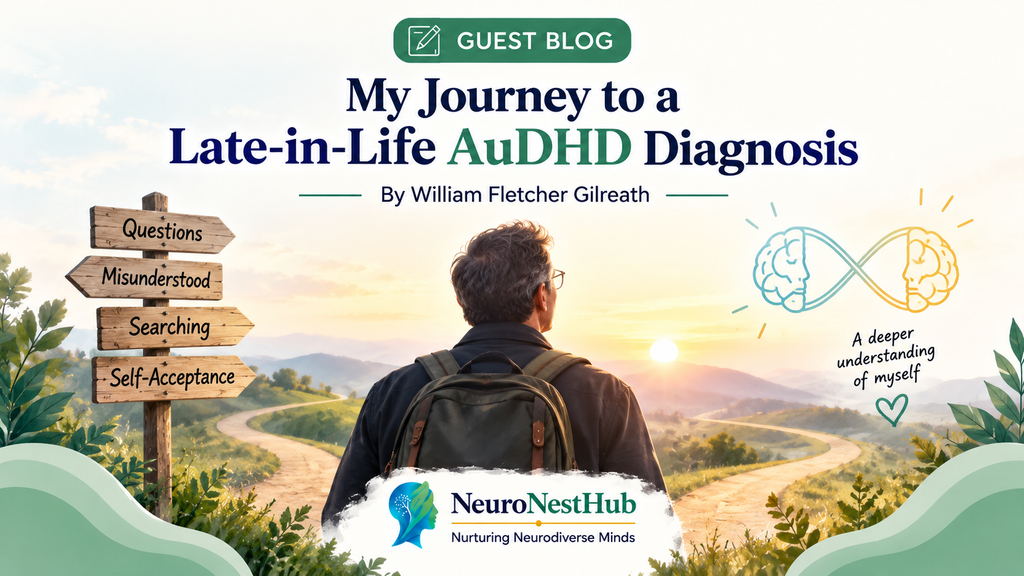
In this guest blog, William Fletcher Gilreath shares his deeply personal journey of receiving an autism diagnosis later in life and eventually recognising himself as AuDHD. Drawing from decades of lived experience, William reflects on feeling different, navigating earlier diagnoses, discovering autism, recognising the intersection of autism and ADHD, and the ongoing journey toward self-understanding and self-acceptance.
About the Guest Author
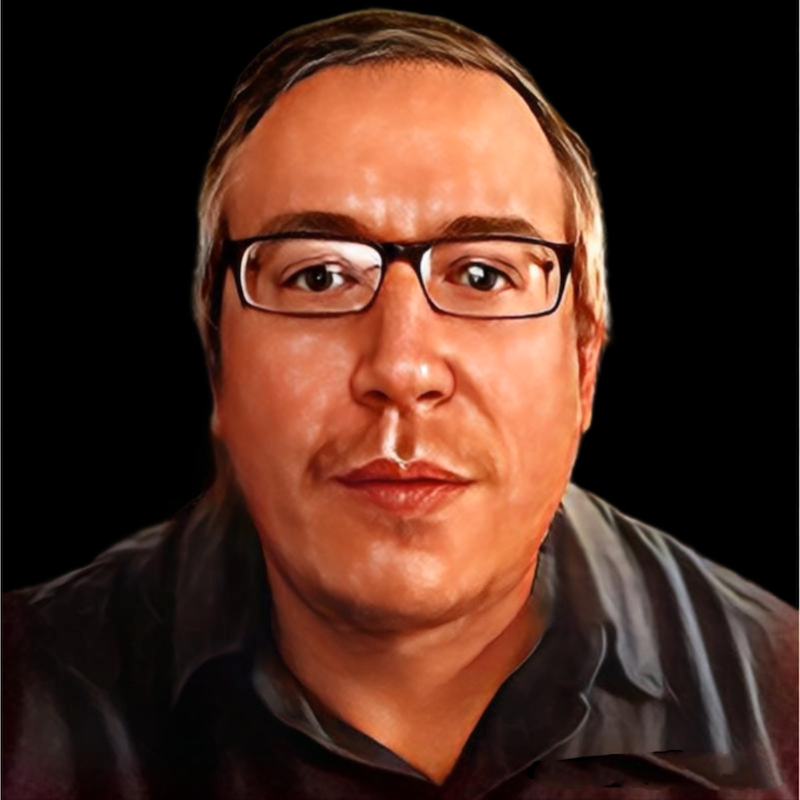
William Fletcher Gilreath is a writer, computer scientist, mathematician, and software engineer whose work brings together technology, mathematics, and storytelling. With three decades of experience in software development, he has worked on programming languages, algorithms, and computer architecture. Alongside his technical career, William writes narrative fiction, essays, and books on computing and mathematics, with fiction spanning thriller, satire, and science fiction.
Diagnosed with autism later in life and identifying as an AuDHD individual, William advocates for neurodiversity through his writing and speaking. He shares his experiences, insights, and perceptions to contribute to a greater understanding of neurodivergent lives. His creative world brings together code, equations, and stories- different forms of expression that reflect his curiosity and the way he experiences and makes sense of the world.
Guest Blog by William
I am AuDHD. But the journey from knowing that I was somehow different to understanding why and eventually receiving a late-in-life diagnosis was not a simple process of discovery or realisation.
It was a journey of finding the right question.
Finding the Question Behind My Late-in-Life AuDHD Diagnosis
There are times when we may know the answer, but the more important thing is discovering the question.
That was my experience as I tried to understand who I was and why I perceived and experienced the world differently from those around me.
For much of my life, I simply knew that I was different. I often felt “out of phase” with reality. I noticed things by their absence. Among my peers, I was the eccentric, colourful, strange one.
Emily Dickinson captured something of this experience in her poem The Curious Wine Book (Fascicle 15, 1862), particularly in these lines:
“And Something’s odd – within –
That person that I was –
And this one – do not feel the same –
Could it be Madness – this?”
For me, the “madness” was not knowing what was different. It was the feeling that something inside me was odd, that the person I was did not feel quite the same as the person I thought I was supposed to be.
The answer was myself.
But the question was: What am I?
This reminded me of the stories of superheroes who know they are different and possess unique ways of seeing or experiencing the world, but do not yet understand what makes them different. They know they are the answer, but they do not yet know the question.
That was my experience.
I eventually received a diagnosis of autism later in life and, years afterwards, came to understand that I had ADHD. Together, autism and ADHD explained much of the neurodivergent experience I had struggled to understand throughout my life.
But getting there was far from straightforward.
A False Start
My journey had a false start.
In my late teenage years, I experienced severe depression and attempted suicide. At the time, my father was dying of cancer, while I was trying to graduate from community college, apply to universities, find scholarships, and get a job. The overload became too much, and I had no effective way of coping.
I was diagnosed with bipolar disorder, then later with a severe and relatively rare personality disorder.
Neither diagnosis felt right to me.
Autism was known at the time, but it was not part of the psychological mainstream in the way it is today. The diagnoses I received felt hollow. They did not seem to explain the differences I had experienced throughout my life.
I still knew something was missing.
The First Step Toward My AuDHD Journey
My first meaningful step came when I was at university.
I struggled with distractions, sensory stimuli, and perceptions that made focusing in class extremely difficult. I went to the counseling center and was diagnosed with what was then called ADD, or attention deficit disorder.
ADD was a commonly used diagnosis in the mid-1990s. For me, it provided an important piece of the puzzle.
The diagnosis helped explain why I could be hyper, energetic, bouncy, and creative while also being easily distracted and irritated. It also helped me understand some of the ways my senses affected my attention.
I noticed things that caught my visual attention, odours that others seemed not to notice, sounds that interrupted me, and sensations I experienced through touch.
The diagnosis gave me an explanation for some things.
But it did not explain everything.
After graduating from university and beginning my career, I continued to feel “out of sync” with reality.
My experiences in the workplace made me feel as though there was some invisible rulebook for interpersonal and social interaction- a virtual “Emily Post” that everyone else seemed to have received except me.
I often learned social and workplace rules only after I had broken them.
I would see the frustration or exasperation of others and think, I should understand this.
But I didn’t.
At times, I was perceived as an eccentric “oddball” or as someone who was obstinate or making “waves” with colleagues.
Yet I continued to feel that something was missing, something that other people seemed to sense about me but that I could not identify in myself.
That created a deep sense of incompleteness.
I felt like an unfinished work.
Discovering Autism Later in Life
The next major step in my journey came unexpectedly.
In 2015, I was involved in an automobile accident and experienced a concussion. Afterwards, I behaved erratically and experienced extreme anxiety, fear, and mistrust surrounding my own actions.
I was placed under observation at a psychiatric hospital.
During that time, clinicians observed my interactions, behaviour, and actions. I was eventually told that I had what was then called Asperger’s Syndrome, sometimes described at the time as “high-functioning autism.”
Today, autism is understood as a spectrum, and Asperger’s syndrome is no longer a separate diagnosis in the DSM-5. However, this was the terminology used in my diagnosis, and it was the word that first introduced me to the possibility that I was autistic.
At first, I was sceptical.
After my previous experiences with diagnoses, I had developed a deep distrust of psychological professionals. And of all the diagnoses I had encountered, this one left me particularly stunned.
Autism?
Me?
I had watched documentaries about autism in college. I had seen autism represented in films. But now I was being told that I was autistic.
I struggled with the realisation.
Eventually, however, I began learning more about autism and looking back at my life through a different lens. In hindsight, the diagnosis began to make sense.
But understanding the diagnosis brought another emotional experience: grief.
I realised that I was grieving the person I had believed myself to be: a “normal” or “regular” human being.
Now I had another identity to understand: an autistic person.
Understanding AuDHD and Finding the Missing Piece
The final piece of the puzzle came in 2019, when I began reading about autism and ADHD occurring together, often referred to as AuDHD.
The more I learned, the more I recognised myself.
I understood the autistic aspects of my experience. I also recognised the ADHD aspects. But when I considered them together, something else became apparent.
For me, AuDHD was not simply two separate labels placed side by side.
It felt like a unique combination that shaped how I experienced the world.
I sometimes think of it like an alloy. Iron has its own properties, and when combined with other elements, it can produce steel, a material with its own characteristics.
Similarly, autism and ADHD each contributed to my experience, but together they created something that felt distinctly my own.
As I continued learning about AuDHD, I experienced something I had not expected:
relief.
Rather than simply accepting another label or category, I wanted to understand what autism and ADHD meant for my cognition, perception, communication, and experience of the world.
For the first time, I had a direction.
I had a path to follow to understand who I was.
Self-Acceptance After a Late-in-Life AuDHD Diagnosis
If I was not a “normal” person, then what kind of person was I?
That question is still part of my journey.
I am still a work in progress.
Living means continuing to learn about myself to understand who I am, how I experience the world, and what meaning I can make from that experience.
I think of myself as an unfinished sculpture being shaped, or a painting still being painted.
But there is an important difference.
I am the artist completing the work.
After grieving the person I once thought I was, I had to begin accepting the person I actually am: an AuDHD, neurodivergent person.
Self-acceptance takes time.
It requires learning, experiencing, questioning, and sometimes unlearning.
One of the hardest parts is figuring out what needs to be unlearned.
I have had to challenge ideas about what a person is “supposed” to be, how a person is “supposed” to behave, and what it means to be “normal.”
The most important realisation has been simple:
I am not better than anyone else, and I am not worse than anyone else.
I am still human.
A late-in-life diagnosis did not make me less human. It gave me a framework for understanding parts of myself that had remained unexplained for much of my life.
The Journey Continues Beyond Diagnosis
At last, later in life, I realised that I had carried the answer with me for much of my lifetime.
What I had been missing was the question.
The question became:
What is AuDHD?
And the answer became:
I am.
Now the journey continues.
I have the question. I have the answer. But I am still searching for a deeper understanding of what my lived experience means and how my perceptions have shaped the person I have become.
I continue to ask:
Who and what is William Fletcher Gilreath?
The journey continues not because I lack an answer, but because knowing the answer opens the door to further questions.
In Valiant Quest, a multi-couplet epic poem I wrote in early 1991 while hospitalised for depression and after a suicide attempt, I wrote two lines that now seem particularly meaningful to me:
“For now I had discovered my noble self,
that is worth more than any material wealth.”
And later:
“I had the knowledge that only I could see,
my true being, and only me.”
At the time, I did not know how much those words would come to mean.
Now I know more about my true being.
And my journey is no longer about trying to become someone else.
It is about understanding myself and learning to be who I am in this lifetime.
Connect with the Guest Author
If William and his insights resonated with you, you can learn more about his work and connect with him on his website and LinkedIn.
This article was contributed to NeuroNestHub as part of our community voices and guest contributor initiative, where lived experiences, professional insights, and diverse perspectives come together to foster awareness, empathy, and meaningful conversations around neurodiversity, mental health, and inclusive leadership.
Discover real stories, practical resources, and a growing community at NeuroNestHub. If you have a story to share, we’d love to hear from you: https://neuronesthub.com/