
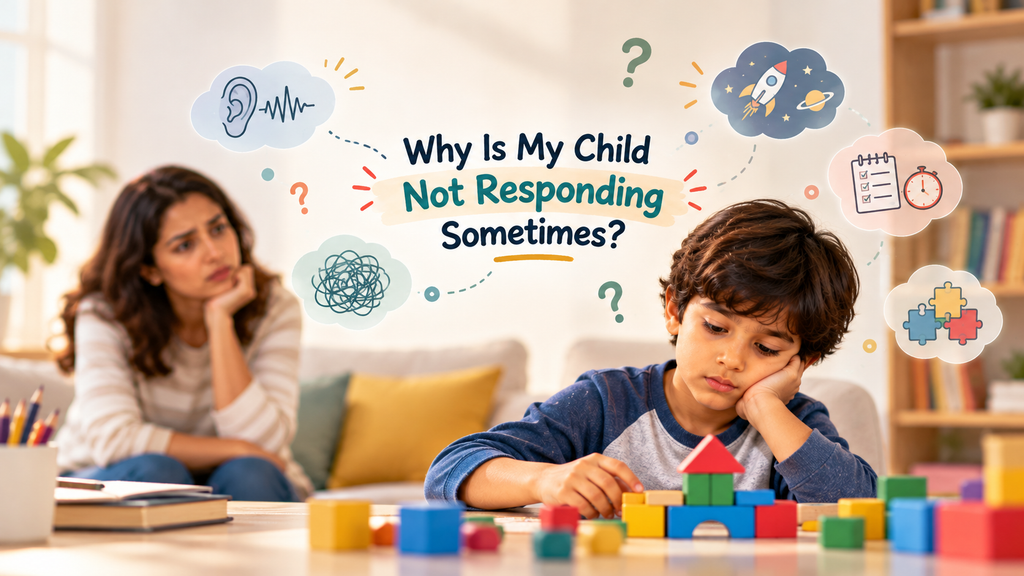
Have you ever called your child’s name and received no response?
You ask again.
Nothing.
You ask a third time, perhaps a little louder.
Suddenly, your child looks at you and says, “What?”
Later that same day, you say something from another room, and your child immediately responds.
It can be confusing.
Parents may wonder:
“Did my child hear me?”
“Are they ignoring me?”
“Why do they respond sometimes but not other times?”
For parents of neurodivergent children, this inconsistency can be particularly difficult to understand. A child may appear to hear and respond perfectly well in one situation and seem completely unavailable in another. If your child also struggles to respond when called by name, read our guide on why your child may not respond to their name.
Research suggests that attention, response variability, motivation, auditory processing, sensory demands, and the complexity of the environment can all influence how a child responds. However, not responding is not, by itself, evidence of ADHD, autism, or any other neurodevelopmental condition.
The important question is not simply whether a child responds.
It is what is happening around them when they do and do not respond.
Why Is My Child Not Responding Sometimes?
A child can hear a sound without fully attending to or processing the information contained in it.
These are related but different processes.
Imagine saying:
“Please stop playing, put the blocks away, get your shoes, and come downstairs.”
Your child may hear your voice.
But hearing the instruction is only the first step.
They also need to:
- shift attention away from what they are doing,
- identify that the message is directed toward them,
- process the words,
- remember the instruction,
- understand what is expected,
- organize a response, and
- act on that response.
A difficulty at any point in this sequence can look like “not listening.”
This is particularly relevant when a child is already deeply engaged in an activity or when the environment contains competing sounds, movement, conversations, or other distractions.
Is My Child Not Responding Because They Are Not Listening?
Not necessarily.
In everyday conversation, we often use hearing, listening, attending, understanding, and responding as though they mean the same thing.
They do not.
A child may hear their name but not orient toward the speaker immediately.
They may orient toward the speaker but need additional time to process the instruction.
They may understand the instruction but struggle to shift from their current activity.
Or they may be overwhelmed by competing sensory information.
Research in ADHD provides one important explanation for why responses can vary.
ADHD and response variability
Children with ADHD are not simply “unable to pay attention.” Their attention and performance can fluctuate.
Kuntsi and Klein (2012) reviewed research on intra-individual variability in ADHD and noted that fluctuations in performance- particularly reaction-time variability- are consistently associated with ADHD across childhood and adulthood.
A large meta-analysis by Kofler et al. (2013) examined 319 studies and found greater reaction-time variability among children and adolescents with ADHD compared with typically developing groups. Importantly, the researchers also noted that increased variability is not completely specific to ADHD.
This distinction matters.
A child who responds immediately in one situation and slowly in another is not necessarily choosing whether to listen.
Their moment-to-moment attention may simply not be equally available in every situation.
Why Does My Child Respond Better Sometimes?
Context matters.
Research has found that ADHD-related performance can change depending on the characteristics of the task and the level of engagement.
For example, Carlson and Tamm (2000) studied children with ADHD and typically developing children under different task and reward conditions. Children with ADHD performed relatively better on high-interest tasks, and reward contingencies affected aspects of their performance and motivation.
More recent research has also examined task-related motivation.
Morsink et al. (2021) studied children and adolescents with ADHD and found that characteristics of a task influenced how motivating it was perceived to be. Their findings suggested that cognitively challenging tasks were particularly less motivating for participants with ADHD and that task motivation was related to academic functioning.
This does not mean that children with ADHD only listen when something is interesting.
Rather, it reminds us that attention is influenced by context.
A child who is absorbed in a preferred activity may respond differently from the same child when they are tired, bored, overwhelmed, or being asked to stop something they enjoy.
How ADHD Can Affect Attention and Response
ADHD involves persistent patterns of inattention and/or hyperactivity-impulsivity that interfere with functioning.
One feature relevant to this discussion is difficulty maintaining attention and regulating behavior.
Research has repeatedly demonstrated increased variability in cognitive performance among children with ADHD.
In a study of children with ADHD, de Zeeuw et al. (2008) found differences in response speed, accuracy, inhibitory performance, and intra-individual variability compared with typically developing children.
This helps explain why a child’s performance may not look the same from moment to moment.
The child may be capable of responding.
But being capable of responding and responding consistently are not necessarily the same thing.
That distinction can be important for parents.
For a broader understanding of the signs parents may notice, read our guide to ADHD symptoms in children.
How Autism Can Affect Auditory and Social Processing
A different set of considerations can arise for autistic children.
Autism is associated with differences in social communication and may also involve differences in how sensory information is processed.
Research has found evidence of atypical auditory processing in autism.
In a major review, O’Connor (2012) reported that auditory processing differences in autism can occur at several levels, from basic auditory features such as pitch and loudness to more complex processing involving speech and prosody.
More recent research continues to examine this relationship.
For example, Gallo et al. (2026) studied auditory processing and communication in autistic children and adolescents. They found associations between specific aspects of auditory processing and verbal and nonverbal communication abilities.
This does not mean that every autistic child has an auditory processing difficulty. Understanding the reasons behind a child’s behaviour can help parents look beyond what they observe. Explore our article on understanding autism and ADHD behaviour.
It also does not mean that a child who does not respond is necessarily autistic.
Rather, it reminds us that the pathway from hearing a sound to understanding and responding to communication can be more complicated than it appears from the outside.
Why Children May Respond Differently From One Moment to Another
There is rarely one explanation.
A child’s response may change depending on several factors.
1. What they are doing
A child deeply engaged in a preferred activity may not immediately shift attention when someone speaks.
2. How complicated the instruction is
“Come here” requires less processing than:
“Put your toys away, get dressed, pack your bag, and come downstairs.”
3. How much competing information is present
A noisy classroom, television in the background, several people talking, or a busy environment can make communication more demanding.
4. Fatigue
A tired child may have fewer cognitive resources available for attention and self-regulation.
5. Emotional state
Stress, frustration, anxiety, or excitement can influence how readily a child processes and responds to information.
6. Sensory demands
Some children may find particular sounds, environments, or combinations of sensory input overwhelming.
7. Motivation and task demands
The characteristics of the task can influence engagement, particularly for children with ADHD.
8. Processing time
Some children may need additional time before responding.
A pause does not automatically mean refusal.
Could Sensory Overload or Processing Time Be Involved?
Sometimes a child may appear to ignore a parent because the environment has become too demanding.
Consider a child returning from school.
They have spent hours listening to teachers, managing classroom expectations, navigating social interactions, and responding to sensory information.
They come home and immediately begin playing quietly.
A parent calls:
“Come and eat.”
No response.
The parent calls again.
Still nothing.
It can be tempting to interpret this as defiance.
But another possibility is that the child is deeply engaged in an activity that helps them regulate after a demanding day.
This is why context matters.
The same child who does not respond immediately after school may respond quickly later in the evening.
The behavior has changed.
But so has the child’s internal state and environment.
Some children also find particular sounds or noisy environments overwhelming. Learn more in our article on why children cover their ears.
What Parents Can Try at Home
Understanding the possible reasons does not mean parents have to repeat themselves endlessly.
Instead, small changes in communication can sometimes make expectations clearer.
Get the child’s attention first.
Rather than giving an instruction from another room, move closer and, when appropriate, use the child’s name.
Give one instruction at a time.
Instead of:
“Put your shoes away, get your bag, change your clothes, and come for dinner.”
Try:
“Please put your shoes away.”
Then give the next instruction.
Allow processing time
After giving an instruction, pause before immediately repeating it.
Some children need additional time to shift attention and process what they have heard.
Reduce competing distractions
If possible, turn down the television or move away from a noisy environment when giving an important instruction.
Use visual supports
A visual checklist can reduce the amount of information a child has to remember verbally.
Check understanding
Instead of repeatedly asking:
“Did you hear me?”
try:
“Tell me what you need to do first.”
This can help distinguish between hearing the instruction and understanding it.
Notice patterns
Parents can keep track of when their child is most likely not to respond.
Is it:
- After school?
- During screen time?
- In noisy environments?
- When tired?
- During transitions?
- When several instructions are given together?
- When the task is difficult?
Patterns can provide useful information.
When Should Parents Seek Professional Evaluation?
Occasional non-response is part of ordinary childhood.
Children become absorbed in activities. They become tired. They get distracted. They sometimes simply do not want to stop what they are doing.
Concern becomes more important when difficulties are persistent, occur across situations, and interfere with everyday functioning.
For example, parents may want to discuss their concerns with a qualified professional if a child consistently struggles with:
- following age-appropriate instructions,
- sustaining attention,
- responding to communication,
- understanding spoken language,
- functioning at school,
- participating in social interactions, or
- managing everyday activities.
An evaluation should look at the child’s overall developmental and functional profile rather than focusing on one behavior.
For ADHD, professional assessment considers symptoms, impairment, developmental history, and functioning across settings. Other possible explanations and co-occurring conditions should also be considered.
For autism or communication concerns, assessment may include social communication, language, developmental history, and other relevant areas of functioning.
A child who does not respond consistently may need understanding, not a quick label.
The Question Behind the Question
When parents ask:
“Why does my child listen sometimes and not respond other times?”
they are often really asking:
“Is my child ignoring me, or is something making it difficult for them to respond?”
That is a much more useful question.
A child’s inconsistent response may reflect attention, engagement, processing, sensory demands, communication differences, fatigue, motivation, or many other factors.
And sometimes, there may be no neurodevelopmental explanation at all.
The goal is not to assume that every behavior is a symptom.
The goal is to look at the pattern, context, frequency, and impact of the behavior.
Before saying:
“My child is not listening.”
it may be worth asking:
“Did my child notice me?”
“Did they have time to process what I said?”
“Was the environment demanding?”
“Was the instruction clear?”
“What was happening immediately before this?”
These questions do not remove boundaries or expectations.
They simply help us understand the child more accurately.
Final Takeaway
A child who responds immediately in one situation and appears not to respond in another is not necessarily being defiant, inattentive, or deliberately ignoring an adult.
For some neurodivergent children, differences in attention regulation, response variability, auditory processing, motivation, sensory demands, or communication can contribute to inconsistent responses.
Research also reminds us that these patterns are not unique to ADHD or autism, and a single behavior cannot establish a diagnosis.
Sometimes the most helpful shift is from:
“Why isn’t my child listening?”
to:
“What might be affecting my child’s ability to notice, process, and respond right now?”
That change in perspective can turn frustration into observation, and observation can lead to better support.
Discover real stories, practical resources, and a growing community at NeuroNestHub. If you have a story to share, we’d love to hear from you: https://neuronesthub.com/
References
Carlson, C. L., & Tamm, L. (2000). Responsiveness of children with attention-deficit-hyperactivity disorder to reward and response cost: Differential impact on performance and motivation. Journal of Consulting and Clinical Psychology, 68(1), 73–83. https://doi.org/10.1037/0022-006X.68.1.73
de Zeeuw, P., Aarnoudse-Moens, C., Bijlhout, J., König, C., Post Uiterweer, A., Papanikolau, A., Hoogenraad, C., Imandt, L., de Been, D., Sergeant, J. A., & Oosterlaan, J. (2008). Inhibitory performance, response speed, intraindividual variability, and response accuracy in ADHD. Journal of the American Academy of Child & Adolescent Psychiatry, 47(7), 808–816. https://doi.org/10.1097/CHI.0b013e318172eee9
Gallo, A., Sabes, J. H., & Demopoulos, C. (2026). Auditory processing and communication in autism: Exploring verbal abilities and vocal affective cues. Frontiers in Psychiatry, 17, 1754358. https://doi.org/10.3389/fpsyt.2026.1754358
Kofler, M. J., Rapport, M. D., Sarver, D. E., Raiker, J. S., Orban, S. A., Friedman, L. M., & Kolomeyer, E. G. (2013). Reaction time variability in ADHD: A meta-analytic review of 319 studies. Clinical Psychology Review, 33(6), 795–811. https://doi.org/10.1016/j.cpr.2013.06.001
Kuntsi, J., & Klein, C. (2012). Intraindividual variability in ADHD and its implications for research of causal links. Current Topics in Behavioral Neurosciences, 9, 67–91. https://doi.org/10.1007/7854_2011_145
Morsink, S., Sonuga-Barke, E. J. S., Van der Oord, S., Van Dessel, J., Lemiere, J., & Danckaerts, M. (2021). Task-related motivation and academic achievement in children and adolescents with ADHD. European Child & Adolescent Psychiatry, 30(1), 131–141. https://doi.org/10.1007/s00787-020-01494-8
O’Connor, K. (2012). Auditory processing in autism spectrum disorder: A review. Neuroscience & Biobehavioral Reviews, 36(2), 836–854. https://doi.org/10.1016/j.neubiorev.2011.11.008
NeuroNestHub note: This article is intended for educational and awareness purposes. It does not diagnose ADHD, autism, auditory processing disorder, or any other condition and does not replace an evaluation by a qualified professional.