
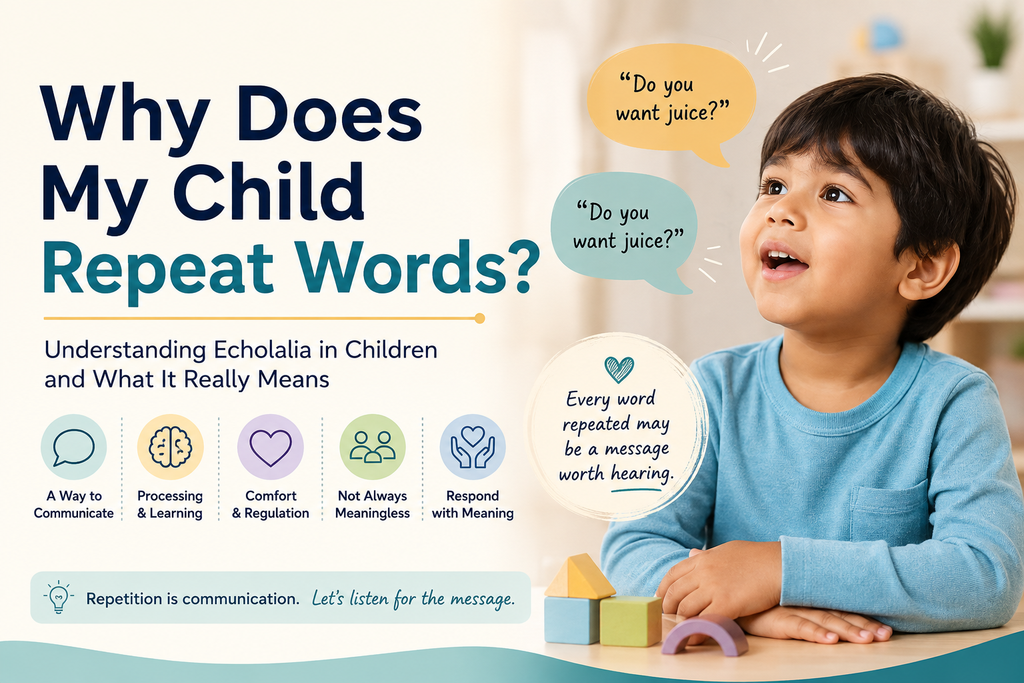
Echolalia in children refers to repeating words, phrases, or sentences a child has heard from another person, a television program, a book, or another source. A child might immediately repeat a question instead of answering it, or repeat a phrase from a favourite cartoon hours or days later.
For parents, this can sometimes be confusing: “Why is my child repeating the same words instead of answering me?”
The important point is that repetition is not necessarily meaningless. For some children, particularly autistic children, echolalia can be connected to communication, language processing, memory, interaction, or self-regulation. At the same time, echolalia is not exclusive to autism and should never be interpreted in isolation as a sign of a particular diagnosis.
What Is Echolalia in Children?
Echolalia can be immediate or delayed.
Immediate echolalia occurs when a child repeats something shortly after hearing it.
For example:
Parent: “Do you want some juice?”
Child: “Want some juice?”
Delayed echolalia occurs when a child repeats language heard earlier. A child may repeat a line from a cartoon, story, conversation, or familiar routine hours, days, or even longer afterwards.
Researchers have studied echolalia for decades. Rydell and Mirenda (1994), for example, found that immediate and delayed echolalia could serve different purposes in young autistic children. Their findings suggested that repeated speech could function as a response, request, assertion, organisational strategy, or cognitive aid rather than simply being meaningless copying.
Why Does Echolalia in Children Happen?
No single explanation explains why a child repeats words. The same behaviour may have different meanings in different children and situations.
1. Language Processing
Some children may repeat language while processing what they have heard.
Repeating a question can sometimes provide additional time to understand it and formulate a response. Earlier research by Roberts (1989) found that autistic children with poorer receptive language skills produced more echolalic speech than those with stronger receptive language abilities.
This does not mean that every child who repeats words has a language difficulty. It highlights why the context of the repetition matters.
2. Communication
A repeated phrase may actually be an attempt to communicate.
A child who repeatedly says, “Do you want a snack?” might actually be communicating that they want a snack because that is the phrase they have learned in that situation.
Research by Xie, Pascual, and Oakley (2023) examined echolalic speech in eight Chinese autistic children and found that repeated language was often used for functions including naming, describing, developing a topic, maintaining conversation, and cognitive strategies.
This is an important reminder: we need to understand the message behind the repetition rather than focusing only on the repetition itself.
3. Familiarity and Predictability
Children may use familiar phrases because predictable language feels easier to access.
A repeated phrase from a favourite show, book, or daily routine may provide a familiar linguistic structure when the child is unsure what to say.
4. Memory and Learning
Repetition can also be part of language learning.
Children naturally learn language by hearing words and phrases repeatedly. For some children, particularly children developing language differently, repeated phrases may remain an important part of how they practise and use language.
5. Regulation or Coping
Sometimes repeated language occurs during excitement, anxiety, transitions, or overwhelming situations.
In these circumstances, repetition may accompany other forms of self-regulation. Understanding when the echolalia occurs can therefore be as important as understanding what the child says.
Echolalia and Autism: What Does Research Say?
Echolalia is particularly well documented in autistic children, but it is not diagnostic of autism on its own.
A major review by Kjelgaard and Tager-Flusberg (2001) and later research have challenged the idea that autistic communication can be understood simply by identifying isolated language behaviours. Echolalia needs to be considered alongside the child’s broader communication and developmental profile.
More recent evidence strengthens this perspective.
McAllister, McFayden, and Harrop (2025) examined reports from 2,555 autistic children and adolescents aged 4–17 years from the Simon Simplex Collection. The researchers found that echolalia was reported in as many as 90% of participants at some point in development. They also found associations between echolalia, verbal ability, age, and repetitive behaviours. Importantly, their findings supported viewing echolalia as having both functional communication and repetitive-behaviour dimensions, rather than assuming that every instance has the same purpose.
This distinction matters for parents. A child repeating words does not automatically mean, “My child has autism.” Instead, it may be one piece of information about how that particular child communicates.
What About Delayed Echolalia?
Delayed echolalia can sometimes be especially difficult for adults to interpret because the connection between the original phrase and the child’s current situation may not be obvious.
For example, a child may repeatedly say a line from a cartoon when they are upset, excited, requesting something, or trying to initiate interaction.
Rather than immediately saying, “That doesn’t make sense,” adults can ask themselves:
- What happened immediately before the child said it?
- Where did this phrase originally come from?
- Does the phrase occur in particular situations?
- Could the child be requesting, commenting, protesting, or seeking connection?
- What is the child trying to communicate?
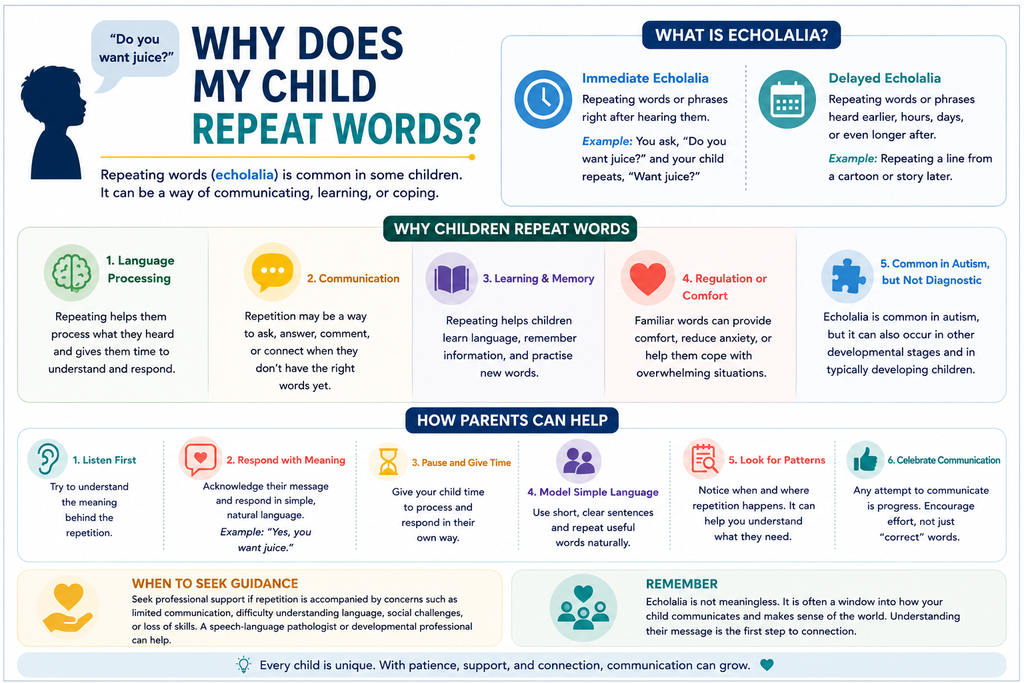
How Parents Can Respond to Echolalia in Children
The goal should not automatically be to stop repetition.
Instead, try to understand and support the communication behind it.
Respond to the Possible Meaning
If your child repeats:
“Do you want milk?”
and you suspect they are requesting milk, you might respond:
“Yes, you want milk. Let’s get some milk.”
This acknowledges the child’s communication while providing a more direct language model.
Use Simple, Natural Language
Short, meaningful sentences can make communication easier to process.
Instead of repeatedly asking questions, try making comments or offering choices:
“Milk or water?”
“You want the red cup.”
Give Your Child Time
After speaking, pause.
Some children need additional processing time before responding. Immediate repetition should not necessarily be interpreted as refusal, lack of understanding, or deliberate non-compliance.
Look at the Context
Keep a simple note of when the repetition occurs.
You may begin to notice patterns around:
- transitions
- hunger or tiredness
- excitement
- sensory overload
- requests
- social interaction
- favourite activities
These patterns can help parents and professionals understand the function of the language.
When Should Parents Seek Professional Guidance?
Echolalia alone does not establish a diagnosis. However, professional guidance may be useful when repetition occurs alongside broader concerns about communication or development- for example, difficulty understanding language, limited functional communication, loss of previously acquired skills, difficulty engaging socially, or significant frustration around communication.
A speech-language pathologist can assess receptive and expressive language, functional communication, and the context in which echolalia occurs. If there are broader developmental concerns, a qualified developmental or mental-health professional can help determine whether a comprehensive assessment is appropriate.
Parents should also be cautious about approaches that focus solely on eliminating echolalia.
Blackburn et al. (2023) systematically reviewed 15 studies of interventions targeting echolalia in autistic children. Although several interventions reduced observed echolalia, the authors highlighted major differences in definitions, methods, and outcome measures, and rated the overall quality of the evidence as very low. They concluded that the evidence was insufficient to make strong clinical recommendations for eliminating echolalia.
Repetition Is Communication Worth Understanding
When a child repeats words, it can be tempting to focus on the behaviour itself:
“Why does my child keep saying that?”
A more helpful question may be:
“What might my child be communicating through those words?”
Echolalia in children can be part of language development, communication, processing, interaction, or regulation. Its meaning differs from child to child.
The goal is not simply to make a child sound more typical. The goal is to help the child communicate, connect, understand, and be understood.
Repetition may be the message we have not yet learned to hear.
Discover real stories, practical resources, and a growing community at NeuroNestHub. If you have a story, insight, or experience to share, we’d love to hear from you: https://neuronesthub.com/
References
Blackburn, C., Tueres, M., Sandanayake, N., Roberts, J., & Sutherland, R. (2023). A systematic review of interventions for echolalia in autistic children. International Journal of Language & Communication Disorders, 58(6), 1977–1993. https://doi.org/10.1111/1460-6984.12931
McAllister, M. L., McFayden, T., & Harrop, C. (2025). Reports of echolalia and related behaviors in autism from parents, teachers, and clinicians: Evidence from the Simon Simplex Collection. Autism Research, 18(3), 528–540. https://doi.org/10.1002/aur.3298
Rydell, P. J., & Mirenda, P. (1994). Effects of high and low constraint utterances on the production of immediate and delayed echolalia in young children with autism. Journal of Autism and Developmental Disorders, 24(6), 719–735. https://doi.org/10.1007/BF02172282
Sterponi, L., & Shankey, J. (2014). Rethinking echolalia: Repetition as interactional resource in the communication of a child with autism. Journal of Child Language, 41(2), 275–304. https://doi.org/10.1017/S0305000912000682
Xie, F., Pascual, E., & Oakley, T. (2023). Functional echolalia in autism speech: Verbal formulae and repeated prior utterances as communicative and cognitive strategies. Frontiers in Psychology, 14, 1010615. https://doi.org/10.3389/fpsyg.2023.1010615