
How Global Neurodiversity Parenting Support Connects Families
When parents first notice that their child experiences the world differently, they often begin a journey filled with questions, emotions, and uncertainty. Some wonder whether their child will be accepted by peers. Others worry about education, independence, relationships, or access to support. Many find themselves searching for answers as they balance hope, advocacy, and everyday family life.
Yet despite differences in language, culture, geography, and support systems, parents of neurodivergent children around the world often describe remarkably similar experiences. The emotions may be universal: the desire to understand their child, the determination to help them thrive, and the hope of building a future where their child is accepted for who they are.
Today, technology has transformed these individual journeys into a global conversation. Through online communities, support networks, webinars, research publications, podcasts, and advocacy organisations, parents are learning from one another in ways unimaginable a generation ago. As a result, global parents help neurodivergent families thrive by sharing practical knowledge, emotional support, and lived experiences that transcend borders.
The value of these global connections extends beyond information. They remind parents that they are not alone. Somewhere across the world, another family has faced similar challenges, celebrated similar milestones, and discovered strategies that may help others navigate their own path.
International Neurodiversity Parenting Support: Why Global Connections Matter
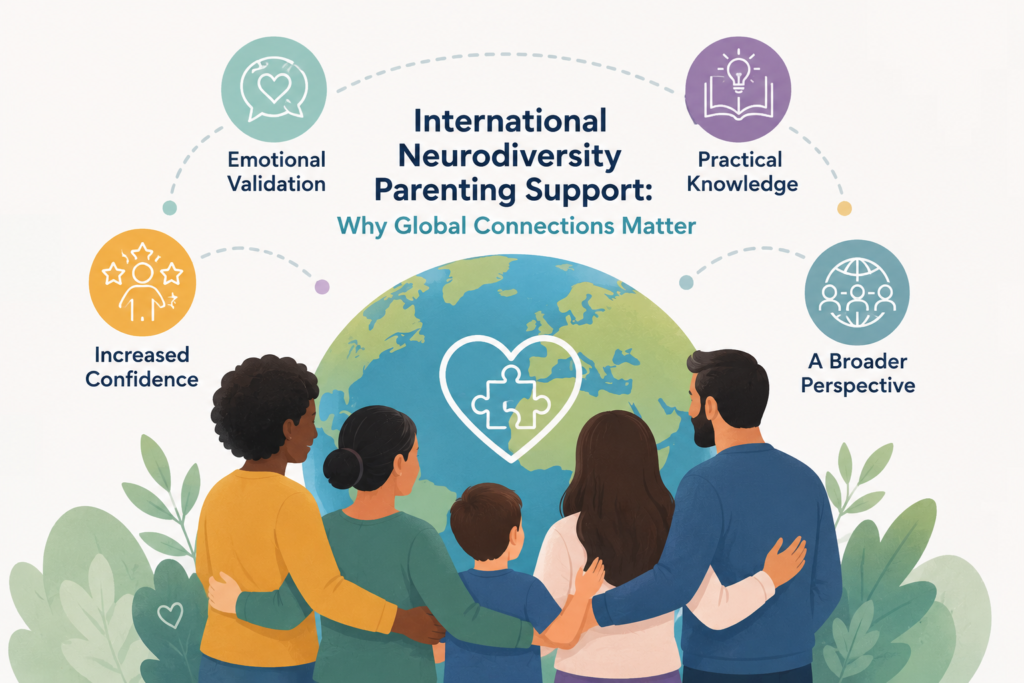
The rise of international neurodiversity parenting support has created opportunities for families to learn from diverse experiences while recognising common goals.
Research suggests that parents of neurodivergent children often experience higher levels of stress than parents of neurotypical children, particularly when navigating diagnosis, educational systems, social expectations, and access to services (Hayes & Watson, 2013). These challenges can sometimes leave families feeling isolated.
Global parent communities help address this isolation by providing:
Emotional Validation
Many parents describe a profound sense of relief when they connect with others who truly understand their experiences. Reading another parent’s story can reduce feelings of loneliness and normalise emotions such as grief, confusion, frustration, and hope.
Practical Knowledge
Parents often share real-world strategies that complement professional guidance. These may include communication techniques, sensory supports, school advocacy approaches, or ways to foster emotional regulation.
Increased Confidence
Learning from families who have successfully navigated similar challenges can help parents feel more empowered in their decision-making and advocacy efforts.
A Broader Perspective
Exposure to diverse viewpoints encourages families to explore different approaches and adapt ideas that align with their child’s individual needs.
Research consistently highlights the importance of social support as a protective factor for parental well-being and resilience (D’Arcy et al., 2024).
The Emotional Power of Global Autism Parenting Experiences
One of the most valuable aspects of global parent communities is the recognition that many experiences are shared.
Parents often describe moments such as:
- Feeling overwhelmed after receiving a diagnosis
- Struggling to explain their child’s needs to others
- Advocating for accommodations in educational settings
- Managing uncertainty about the future
- Celebrating milestones that others may overlook
- Learning to embrace neurodiversity rather than fear it
When parents hear these experiences echoed by families from different parts of the world, they often realize that their challenges are not personal failures. Instead, they are navigating a journey that many others understand deeply.
Similar reflections can be found in NeuroNestHub’s story, “Undiagnosed ADHD in Childhood: What I Wish My Parents Knew,” where the author shares the impact of a late ADHD diagnosis and the understanding they wish had been available earlier.
Research examining families of autistic children found that shared understanding and peer support can contribute positively to parental coping and emotional well-being (Galpin et al., 2018).
In many ways, global parent communities create spaces where families can move from isolation to connection, from uncertainty to knowledge, and from self-doubt to confidence.
Indian Parents of Neurodivergent Children in a Global Learning Community
For many Indian parents of neurodivergent children, awareness of neurodiversity has increased significantly in recent years. However, families may still encounter challenges related to stigma, delayed identification, limited services in some regions, and societal expectations.
Research exploring Indian parents’ experiences of raising autistic children found that many families undergo a lengthy process of understanding developmental differences, seeking explanations, and finding appropriate support (Desai et al., 2012).
Global communities offer Indian parents several important benefits.
Access to Diverse Perspectives
Families can learn how others approach communication, emotional regulation, education, and self-advocacy while adapting these ideas to their own cultural contexts.
Exposure to Neurodiversity-Affirming Approaches
Many international discussions emphasise acceptance, strengths, accommodations, and inclusion rather than focusing exclusively on deficits or limitations.
Greater Awareness of Rights and Advocacy
Parents often gain confidence in advocating for educational supports, accommodations, and inclusive opportunities.
Hope Through Representation
Seeing neurodivergent children, adolescents, and adults thrive in various environments can help families envision positive futures for their own children.
Stories shared by neurodivergent individuals themselves can be especially powerful. In “Living With Autism: The Power of Thinking Differently,” the author offers a personal perspective on autism, self-acceptance, and recognising strengths that are often overlooked.
Importantly, learning is not one-directional. Indian families also contribute valuable perspectives on community involvement, extended family support, resilience, and cultural strengths that enrich global conversations.
Lessons from Neurodiversity Parenting Across Cultures
Although support systems vary across regions, neurodivergent parenting experiences reveal several lessons that resonate across cultures.
Every Child Is Unique
One of the first lessons parents learn is that there is no universal roadmap. Neurodivergent children have diverse strengths, needs, interests, and developmental trajectories.
Global parent communities frequently emphasise the importance of individualised support rather than comparison.
Progress Looks Different for Every Family
Parents often discover that success cannot be measured solely by conventional milestones.
For some children, success may mean:
- Communicating a need independently
- Developing meaningful friendships
- Building self-confidence
- Managing sensory challenges
- Expressing emotions effectively
- Participating comfortably in community activities
This broader definition of success helps families appreciate growth in all its forms.
Acceptance Is as Important as Intervention
Research increasingly supports approaches that prioritise acceptance, belonging, and quality of life alongside skill development (Pellicano & den Houting, 2022).
Parents worldwide are recognising that helping children thrive involves not only teaching skills but also creating environments where they feel valued and understood.
Cross-Cultural Parenting Strategies for Neurodivergent Children
Many effective cross-cultural parenting strategies for neurodivergent children emerge from shared experiences across global communities.
Strength-Based Parenting
Rather than focusing exclusively on challenges, many parents are embracing approaches that identify and nurture their child’s strengths.
Research suggests that strength-based approaches can support positive identity development and psychological well-being (Lei et al., 2020).
Examples include:
- Encouraging special interests
- Recognising talents and abilities
- Celebrating unique perspectives
- Building confidence through competence
Supporting Emotional Regulation
Parents frequently exchange strategies such as:
- Predictable routines
- Visual supports
- Sensory-friendly environments
- Co-regulation techniques
- Flexible communication approaches
These strategies can often be adapted across cultures and settings.
Encouraging Self-Advocacy
Global parent communities increasingly emphasise helping children understand their own needs, preferences, and strengths.
Self-advocacy skills contribute to independence, confidence, and long-term well-being.
Building Inclusive Environments
Families are learning that inclusion involves adapting environments, not forcing children to mask or suppress their authentic selves.
This perspective aligns with growing neurodiversity-affirming frameworks worldwide.
Advantages of Global Learning for Parents
The benefits of connecting with global parent communities extend far beyond information sharing.
Reduced Isolation
Knowing that other families face similar experiences can provide emotional comfort and a sense of belonging.
Increased Resilience
Exposure to stories of perseverance and growth can strengthen parental coping abilities during difficult periods.
Better Problem-Solving
Parents gain access to a wider range of ideas and solutions than may be available within local networks alone.
Greater Hope
Seeing neurodivergent individuals succeed in education, employment, relationships, and community life can help families maintain optimism about the future.
Families also gain inspiration from practical experiences shared by others. In “Neurodiverse Travel: What Our Family Learned,” a family shares their experiences on how flexibility, preparation, and understanding made travel more enjoyable and accessible.
Stronger Advocacy Skills
Learning from experienced parents can improve confidence when communicating with educators, healthcare providers, and policymakers.
Enhanced Family Well-Being
Research indicates that social support can positively influence both parental mental health and family functioning (D’Arcy et al., 2024).
Why Supporting Parents Matters
An important theme emerging from international research is that supporting neurodivergent children requires supporting their caregivers as well.
Parents often balance multiple responsibilities, including:
- Advocacy
- Educational planning
- Therapy coordination
- Emotional support
- Family management
- Financial considerations
Research has shown that caregiver well-being significantly influences family outcomes (D’Arcy et al., 2024).
When parents receive emotional support, reliable information, and opportunities for connection, they are often better equipped to support their children effectively.
Supporting parents is not separate from supporting children; it is an essential part of the process.
Different Cultures, Shared Hope for Neurodivergent Families
Every family raising a neurodivergent child has its own story, shaped by unique circumstances, values, strengths, and challenges. Yet beneath these differences lies a powerful shared experience: the desire to help children feel understood, accepted, and empowered to thrive.
As global parents help neurodivergent families thrive, they create something far greater than an exchange of parenting tips. They build a worldwide community rooted in empathy, resilience, and hope.
Through international neurodiversity parenting support, global autism parenting experiences, and cross-cultural parenting strategies for neurodivergent children, families are discovering that wisdom exists in many places. Every shared story, every piece of encouragement, and every practical insight contributes to a growing movement that values neurodiversity and recognises the potential of every child.
Perhaps the most important lesson from global parent communities is this: while the journey may sometimes feel overwhelming, no family has to walk it alone. Across cultures and continents, parents are learning, supporting, and growing together, creating a more inclusive future for neurodivergent children and their families.
Discover real stories, practical resources, and a growing community at NeuroNestHub, and if you have a story to share, we’d love to hear from you: https://neuronesthub.com/
References
D’Arcy, E., Burnett, T., Capstick, E., Elder, C., Slee, O., Girdler, S., Scott, M., & Milbourn, B. (2024). The well-being and support needs of Australian caregivers of neurodiverse children. Journal of Autism and Developmental Disorders, 54(5), 1857–1869. https://doi.org/10.1007/s10803-023-05910-1
Desai, M. U., Divan, G., Wertz, F. J., & Patel, V. (2012). The discovery of autism: Indian parents’ experiences of caring for their child with an autism spectrum disorder. Transcultural Psychiatry, 49(3–4), 613–637. https://doi.org/10.1177/1363461512447139
Galpin, J., Barratt, P., Ashcroft, E., Greathead, S., Kenny, L., & Pellicano, E. (2018). The dots just don’t join up: Understanding the support needs of families of children on the autism spectrum. Autism, 22(5), 571–584. https://doi.org/10.1177/1362361316687989
Hayes, S. A., & Watson, S. L. (2013). The impact of parenting stress: A meta-analysis of studies comparing the experience of parenting stress in parents of children with and without autism spectrum disorder. Journal of Autism and Developmental Disorders, 43(3), 629–642. https://doi.org/10.1007/s10803-012-1604-y
Lei, J., Russell, A., Ashwin, C., & Brosnan, M. (2020). Autistic strengths-based approaches: A narrative review. Autism in Adulthood, 2(2), 87–95. https://doi.org/10.1089/aut.2019.0055
Pellicano, E., & den Houting, J. (2022). Annual Research Review: Shifting from ‘normal science’ to neurodiversity in autism science. Journal of Child Psychology and Psychiatry, 63(4), 381–396. https://doi.org/10.1111/jcpp.13534
Papoudi, D., Jørgensen, C. R., Guldberg, K., Meadan, H., Cristescu, L., & McGuire, S. N. (2021). Perceptions, experiences, and needs of parents of culturally and linguistically diverse children with autism: A scoping review. Review Journal of Autism and Developmental Disorders, 8(2), 195–212. https://doi.org/10.1007/s40489-020-00210-1