
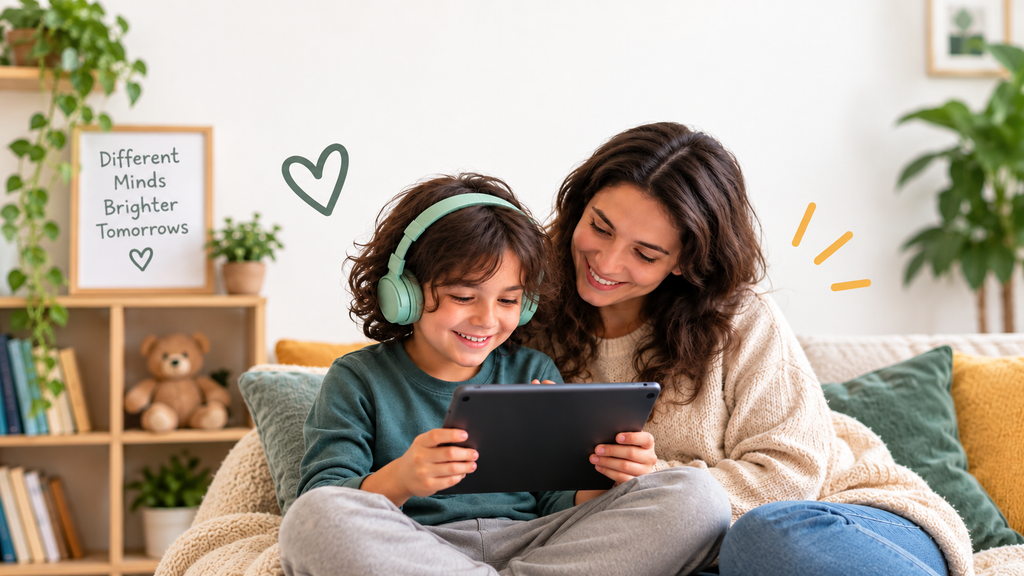
Screen time and neurodivergent kids is a complex topic because technology can serve very different purposes in a child’s life. For some autistic children and children with ADHD, screens may support communication, learning, social connection, creativity, or regulation. At the same time, excessive or poorly timed recreational screen use may interfere with sleep, physical activity, learning, or family routines.
Current research does not establish screen use as a cause of autism or ADHD. Much of the evidence is observational, meaning associations cannot automatically be interpreted as cause and effect. Research also suggests that the relationship may be bidirectional: children with existing neurodevelopmental characteristics may be more likely to use digital media in particular ways.
Therefore, rather than focusing only on the number of minutes a child spends on a device, families can consider time, content, purpose, context, timing, and impact. This article reviews current evidence and offers practical, individualised strategies for families.
Why Screen Use Can Be Different for Neurodivergent Children
For many children, screen use primarily means entertainment. For neurodivergent children, however, technology may have additional functions.
A device might be used for:
- communication or augmentative and alternative communication (AAC);
- education and learning;
- social connection;
- creative activities;
- accessing a strong interest;
- visual schedules or other supports;
- emotional regulation;
- or recreation.
This distinction is important. An AAC device or educational intervention should not automatically be treated in the same way as recreational video viewing.
Research examining information and communication technology use among autistic people has identified potential benefits for communication, interaction, and autonomy, while also emphasising that the evidence base is still developing. (Hassrick et al., 2021).
The question, therefore, should not only be:
“How many hours is my child using a screen?”
It should also be:
“What is my child doing on the screen, and what role is it playing in their life?”
What Research Says About Screen Time and Autism
One of the most important messages for parents is that screen use has not been established as a cause of autism.
A 2023 systematic review and meta-analysis published in JAMA Network Open examined 46 observational studies involving 562,131 participants. The initial analysis found an association between screen time and autism spectrum disorder. However, after accounting for publication bias, the association was no longer statistically significant. The researchers concluded that existing evidence was insufficient to establish a clear relationship or causality. (Ophir et al., 2023).
More recent research continues to explore this relationship. A 2026 systematic review reported that autistic children and young people tended to have higher screen use, but the certainty of the evidence was rated very low. The researchers emphasised the need for better-quality longitudinal studies. (Yuan et al., 2026).
Why might an association appear?
A child who experiences social communication differences, sensory challenges, or difficulty with unstructured activities may naturally prefer predictable digital activities. Parents may also allow additional screen use because it helps their child remain calm or engaged.
This creates an important possibility of reverse causality.
In other words, greater screen use may sometimes respond to a child’s existing needs rather than cause them.
What Research Says About Screen Time and ADHD
Research on screen time and ADHD is similarly complex.
A systematic review of longitudinal studies found evidence of reciprocal associations between digital media use and ADHD symptoms. Children with ADHD symptoms may be more vulnerable to problematic digital media use. At the same time, certain patterns of digital media use may also contribute to later difficulties through factors such as sleep and social relationships. (Thorell et al., 2024).
A meta-analysis has also found an association between higher screen exposure and ADHD symptoms in children. However, these findings should not be interpreted as proof that screen exposure causes ADHD because observational research cannot establish causation by itself. (Liu et al., 2023).
For parents, the practical message is therefore not “screens cause ADHD.”
Instead, children with ADHD may benefit from particularly thoughtful digital routines, especially when screen use interferes with sleep, schoolwork, physical activity, or other important activities.
Screen Time and Sleep
Screen time and sleep are an especially relevant issue because sleep supports attention, learning, emotional regulation, and daytime functioning.
A 2025 systematic review specifically examining screen-based media and sleep in autistic children and adolescents concluded that the available evidence was insufficient to establish a clear causal relationship. The researchers highlighted the limited number and variable quality of available studies. (Cuddihy et al., 2025).
However, this does not mean bedtime screen habits should be ignored.
For an individual child, parents can ask:
- Is screen use pushing bedtime later?
- Does my child become more alert or stimulated?
- Is the child continuing to use the device after getting into bed?
- Does screen use make the bedtime transition harder?
- Is the child getting enough sleep?
If screen use appears to interfere with sleep, families can experiment with a predictable screen-free wind-down routine.
For children who benefit from visual supports, a simple sequence can help:
Screen finished → pajamas → story/music → lights out
The goal is not perfection. It is predictability.
Technology Can Also Support Neurodivergent Children
A balanced discussion should recognise the potential benefits of technology.
Communication
Digital devices can provide important communication support for some autistic children, including access to AAC and speech-generating systems.
A 2024 meta-analysis found evidence supporting interventions involving tablet-based speech-generating devices for individuals with autism, although outcomes varied between studies. (Muharib et al., 2024).
Learning and Development
Digital interventions have also been studied for autistic children and adolescents. A 2024 systematic review and meta-analysis reported beneficial effects in several areas, particularly social-emotional outcomes, although results differed depending on the intervention and skill being targeted. (Wang et al., 2024).
Social Connection and Creativity
Technology may also provide opportunities for:
- connecting with family or peers;
- drawing and digital art;
- music;
- storytelling;
- coding;
- exploring interests;
- and participating in online communities.
Therefore, removing all screens may also mean removing useful opportunities.
The goal should be balanced and purposeful technology use, not necessarily a screen-free childhood.
A Better Way to Think About Screen Time
For neurodivergent children, parents can consider six factors:
1. Time
How long is the child using the device?
Duration still matters, particularly if screen use consistently replaces sleep, movement, learning, or relationships.
2. Content
What is the child watching, playing, creating, or communicating?
Educational, creative, social, and passive entertainment experiences are not identical.
3. Purpose
Why is the child using the screen?
Communication and accessibility use should be distinguished from recreational use.
4. Context
Is the child using technology alone, with a parent, with peers, at school, or as part of an intervention?
5. Timing
When is the screen being used?
Use during bedtime, meals, or schoolwork may have different implications from planned leisure time.
6. Impact
Is screen use interfering with:
- sleep;
- physical activity;
- learning;
- relationships;
- family routines;
- or emotional wellbeing?
This approach gives parents more useful information than a screen-time number alone.
Practical Strategies for Families
Use predictable routines
A visual schedule can show when screen time begins and ends.
Give warnings
Try:
“Ten minutes left.”
Then:
“Five minutes left.”
Then:
“One more minute, then tablet time is finished.”
Use visual timers
A visual countdown may make the passage of time easier to understand for children who find transitions difficult.
Create predictable stopping points.
Whenever possible, finish at a natural endpoint rather than suddenly interrupting an activity.
Use first–then language.
For example:
“First homework, then your game.”
Offer an alternative
Have another activity ready when screen time ends:
- drawing;
- building;
- music;
- sensory play;
- reading;
- outdoor play;
- or another preferred interest.
The aim is not simply “take away the screen.”
It is “help the child transition to something else.”
5 Things Parents Should Know About Screen Use
1. Screens have not been shown to cause autism
Current research has not established that screen use causes autism. Some studies have found associations between screen exposure and autism-related characteristics, but these findings do not prove that one causes the other. Researchers are still studying the reasons behind these associations. (Ophir et al., 2023).
At the same time, this does not mean that screen use has no impact on a child’s development or daily functioning. The amount, type, and timing of screen use may still matter.
What parents can take from this: Do not blame screens for causing autism, but do pay attention to how screen use fits into your child’s overall routine.
2. Screens do not automatically cause ADHD
Research has found associations between higher or problematic screen use and ADHD symptoms. However, this does not prove that screens cause ADHD. Children who already have ADHD may also be more likely to spend time with highly stimulating digital activities or find it difficult to stop using them. (Thorell et al., 2024).
What parents can take from this: Screen use is not an explanation for ADHD, but children with ADHD may need extra support with screen boundaries, transitions, and routines.
3. More screen time does not automatically mean poor parenting
Parents may sometimes rely on screens for practical reasons, including communication, learning, accessibility, or helping a child manage a difficult moment. This does not make them bad parents.
However, frequent reliance on screens can become a concern if screen use begins to replace sleep, physical activity, family interaction, learning, or other meaningful activities.
What parents can take from this: Avoid parental guilt, but also look honestly at whether screen use is helping your child or beginning to interfere with important parts of daily life.
4. Not all screen time is the same but all screen use deserves attention
An AAC device, a video call with grandparents, an educational activity, a creative project, a video game, and hours of passive entertainment are very different experiences.
Some forms of technology may provide genuine benefits, while excessive recreational use may create challenges.
What parents can take from this: Look at what your child is doing on the screen, how long they are doing it, why they are using it, and what the screen may be replacing.
5. There is no single screen-time number for every neurodivergent child
Every neurodivergent child has different needs. A child who uses a device for communication may need access to technology for very different reasons from a child who spends several hours watching entertainment videos.
This does not mean that “anything goes.” Children still need sleep, movement, learning, relationships, play, and time away from digital stimulation.
What parents can take from this: Instead of searching for one perfect number, create boundaries that protect your child’s sleep, health, development, relationships, and daily routines, while allowing technology to be used when it genuinely adds value.
The goal is neither “screens are bad” nor “screens are harmless.”
The goal is to help children develop a healthy relationship with technology.
A Simple Family Checklist
Before changing your child’s screen routine, ask:
- What purpose does the screen serve?
- Is it for functional or recreational use?
- Is my child’s sleep being protected?
- Is screen use replacing movement or meaningful interaction?
- What type of content is my child consuming?
- Does my child need help transitioning away?
- Would a visual timer or schedule help?
- Do we have an alternative activity ready?
- Are we treating communication technology differently from entertainment?
- Are our expectations appropriate for my child’s individual needs?
Conclusion
The conversation about screen time and neurodivergent kids should move beyond the question of whether screens are simply “good” or “bad.”
Research suggests that digital media use can be associated with behavioural, attentional, and sleep-related outcomes, but much of the evidence is observational and cannot establish straightforward cause and effect. In autism research, current evidence does not establish screen use as a cause of autism. Research involving ADHD similarly suggests a complex, potentially bidirectional relationship.
At the same time, technology can support communication, learning, social connection, creativity, and individualised development.
For families, a better approach may be to consider time, content, purpose, context, timing, and impact.
Protect sleep. Protect relationships. Protect movement and learning. Preserve useful technology.
Most importantly, remember that every neurodivergent child is different.
The goal is not necessarily less technology.
The goal is meaningful, balanced, and individualised technology use that supports the child’s everyday life.
Discover real stories, practical resources, and a growing community at NeuroNestHub. If you have a story to share, we’d love to hear from you: https://neuronesthub.com/
References
Cuddihy, A. M., McCormack, D., Cross, J., Craig, S. N., & Fosker, T. (2025). A systematic review of the association between screen-based media device use and sleep outcomes in autistic children and adolescents. Review Journal of Autism and Developmental Disorders. https://doi.org/10.1007/s40489-025-00513-1
Hassrick, E. M., Holmes, L. G., Sosnowy, C., Walton, J., & Carley, K. (2021). Benefits and risks: A systematic review of information and communication technology use by autistic people. Autism in Adulthood, 3(1), 84–95. https://doi.org/10.1089/aut.2020.0048
Liu, H., Chen, X., Huang, M., Yu, X., Gan, Y., Wang, J., Chen, Q., Nie, Z., & Ge, H. (2023). Screen time and childhood attention deficit hyperactivity disorder: A meta-analysis. Reviews on Environmental Health, 39(4), 643–650. https://doi.org/10.1515/reveh-2022-0262
Muharib, R., Walker, V., & Dunn, W. (2024). Effects of interventions involving tablet-based speech-generating devices for individuals with ASD: A meta-analysis. Journal of Autism and Developmental Disorders, 54(12), 4496–4514. https://doi.org/10.1007/s10803-023-06173-6
Ophir, Y., Rosenberg, H., Tikochinski, R., Dalyot, S., & Lipshits-Braziler, Y. (2023). Screen time and autism spectrum disorder: A systematic review and meta-analysis. JAMA Network Open, 6(12), e2346775. https://doi.org/10.1001/jamanetworkopen.2023.46775
Thorell, L. B., Burén, J., Ström Wiman, J., Sandberg, D., & Nutley, S. B. (2024). Longitudinal associations between digital media use and ADHD symptoms in children and adolescents: A systematic literature review. European Child & Adolescent Psychiatry, 33, 2503–2526. https://doi.org/10.1007/s00787-022-02130-3
Wang, T., Ma, Y., Du, X., Li, C., Peng, Z., Wang, Y., & Zhou, H. (2024). Digital interventions for autism spectrum disorders: A systematic review and meta-analysis. Pediatric Investigation, 8(3), 224–236. https://doi.org/10.1002/ped4.12417
Yuan, G., Zhu, Z., Guo, H., Yang, H., Zhang, J., Zhang, K., Zhang, X., Lu, X., Du, J., Shi, H., Jin, G., Hao, J., Sun, Y., Su, P., & Zhang, Z. (2026). Screen time and autism spectrum disorder: A comprehensive systematic review of risk, usage, and addiction. Journal of Autism and Developmental Disorders, 56(4), 1573–1587. https://doi.org/10.1007/s10803-024-06665-z