
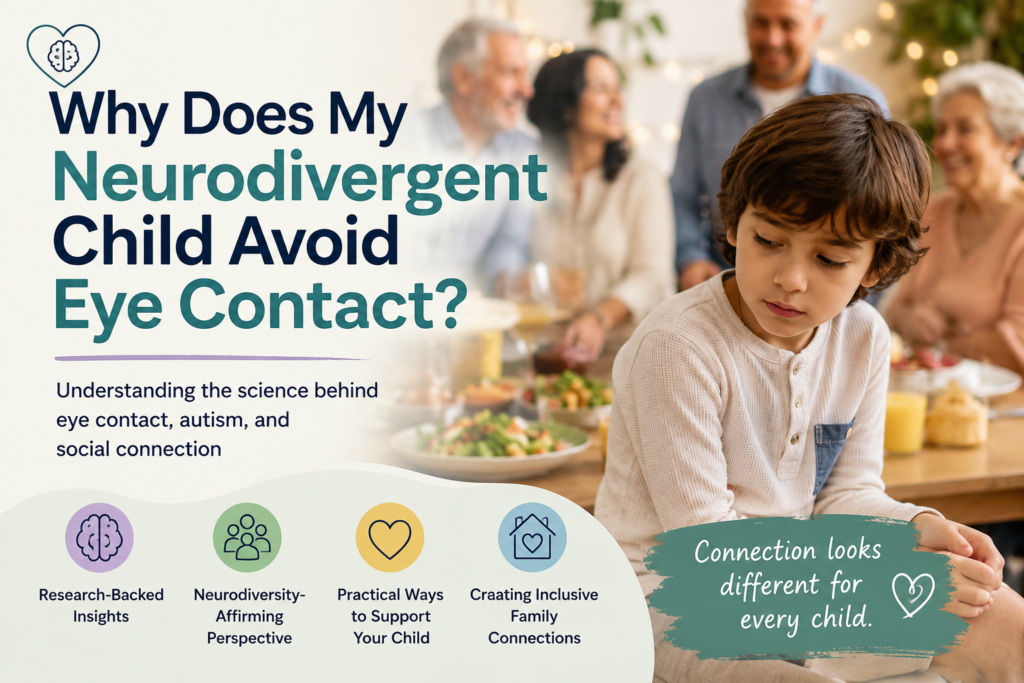
Why Does My Neurodivergent Child Avoid Eye Contact?
At family gatherings, you may notice your child looking away when relatives speak to them. Perhaps an aunt comments, ‘Why won’t he look at me?’ or a grandparent worries that your child seems uninterested. For many neurodivergent children, however, avoiding eye contact is not about avoiding people. Research increasingly suggests it may be a way of managing sensory, emotional, and social demands.
Many parents of neurodivergent children notice a common pattern: their child looks away during conversations, avoids eye contact with relatives, or seems uncomfortable when people expect them to “look at me when I’m talking to you.“
This often becomes especially noticeable during family gatherings, school events, or social celebrations where multiple people are interacting at once.
For years, reduced eye contact was viewed as a social deficit that needed correction. However, recent research tells a more nuanced story. Eye contact is not simply a matter of manners or attention. For many neurodivergent children, particularly autistic children, eye contact can involve complex sensory, emotional, and cognitive demands.
Understanding why your child avoids eye contact can help shift the conversation from “How do I make them do it?” to “What are they experiencing, and how can I support them?“
Eye Contact Is More Complex Than Most People Realise
Many people assume that eye contact is a natural and effortless social behaviour. Yet neuroscience suggests that direct gaze requires the brain to process facial expressions, emotions, intentions, language, and social expectations simultaneously.
Hirsch et al. (2022) found that eye contact activates multiple neural systems involved in social and emotional processing. Their research showed that direct gaze may place different demands on autistic individuals compared to neurotypical individuals.
For some neurodivergent children, maintaining eye contact may require significant mental effort, even when they are fully engaged in a conversation.
This means that looking away does not necessarily indicate disinterest, disrespect, or a lack of connection.
Why Eye Contact May Feel Difficult for Neurodivergent Children

Eye Contact Can Be Sensory Overload
Many neurodivergent children experience differences in sensory processing.
While some people find eye contact comforting or reassuring, others may experience it as intense or overwhelming. Looking directly into someone’s eyes can increase emotional and sensory input to an uncomfortable level.
Stuart et al. (2023) reviewed evidence supporting the “Eye Avoidance Hypothesis,” which proposes that some individuals with autism avoid eye contact because direct gaze triggers heightened emotional and physiological arousal.
In other words, looking away may be a self-regulation strategy rather than a social difficulty.
Looking Away May Help a Child Process Information
Parents often worry that a child who is not making eye contact is not listening.
Research suggests the opposite can sometimes be true.
When a child reduces visual input, the brain may have more resources available for processing language and conversation. Many neurodivergent children report that they can focus better on what someone is saying when they are not simultaneously trying to maintain eye contact.
A child looking at the floor, a toy, or another object may actually be concentrating deeply on the conversation.
Social Situations Increase Cognitive Load
Social interactions require children to interpret facial expressions, body language, tone of voice, and spoken language simultaneously.
For neurodivergent children, managing all of this information at once can be demanding.
Research by Bottein and Hamilton (2024) found that gaze behaviours often differ significantly during real-life social interactions compared with those in structured laboratory settings. This suggests that everyday social environments place greater demands on social attention and communication.
The more socially complex the environment becomes, the more difficult eye contact may feel.
Why Family Gatherings Can Be Particularly Challenging
Family gatherings often create what many neurodivergent children experience as a “perfect storm” of social demands.
These events may include:
- Loud conversations
- Multiple people speaking at once
- Bright lights and unfamiliar smells
- Physical affection such as hugs
- Questions from relatives
- Changes to routine
- Social expectations around greetings and conversation
For a neurodivergent child, these factors can significantly increase stress and sensory load.
When children are already using substantial energy to regulate their environment, maintaining eye contact may become one more demand their brain chooses to reduce.
Myths And Facts About- Why Does Your Neurodivergent Child Avoid Eye Contact?
One of the most persistent myths about autism is that autistic people avoid eye contact because they are not interested in social connections.
Current research challenges this assumption.
Hirsch et al. (2022) demonstrated that differences in eye contact are linked to how social information is processed in the brain rather than a lack of desire for connection.
Similarly, Muuvila et al. (2022) found that autistic children often increase eye gaze naturally when interactions feel motivating, enjoyable, and emotionally safe.
These findings suggest that eye contact differences should not be interpreted as a lack of social interest.
Many autistic children deeply value relationships and connection but may express that connection in ways that differ from societal expectations.
Social Connection Is Bigger Than Eye Contact
One of the most important lessons emerging from neurodiversity-affirming research is that eye contact is only one form of communication.
Yoon, Meadan, and Shic (2026) emphasised that social engagement can occur through many channels, including:
- Shared interests
- Gestures
- Verbal communication
- Facial expressions
- Joint attention
- Parallel play and activities
A child discussing their favourite topic, sharing a drawing, sitting beside a loved one, or bringing someone an object of interest may be expressing meaningful connections even without direct eye contact.
When we focus exclusively on eye contact, we risk overlooking these valuable forms of communication.
Supporting Your Child Without Forcing Eye Contact
Rather than demanding eye contact, many professionals now recommend creating opportunities for comfortable engagement.
Parents can support their child by:
Accepting Different Communication Styles
Listening and engagement do not always look the same for every child.
Reducing Sensory Overload
Providing quiet spaces, breaks, and predictable routines can reduce stress during social events.
Educating Family Members
Helping relatives understand neurodiversity can reduce pressure and create a more accepting environment.
Focusing on Connection Instead of Compliance
Instead of asking:
“Look at me when I’m talking to you.”
Consider saying:
“I know you’re listening. Thank you for sharing your thoughts.”
This approach validates communication without adding unnecessary pressure.
When Should Parents Seek Professional Support?
While differences in eye contact are common among neurodivergent children, parents may wish to consult a developmental paediatrician, psychologist, speech-language pathologist, or occupational therapist if concerns are accompanied by:
- Significant communication challenges
- Difficulty understanding social cues
- Persistent anxiety
- Sensory regulation difficulties
- Concerns about developmental milestones
Professional guidance can help families better understand their child’s unique strengths and support needs.
Conclusion
If your neurodivergent child avoids eye contact, it does not automatically mean they are disengaged, disrespectful, or uninterested in connecting.
Recent research suggests that eye contact differences may reflect sensory processing needs, emotional regulation strategies, cognitive load, or alternative ways of engaging socially.
Perhaps the most important question is not whether a child is looking at us, but whether they feel safe enough to connect with us.
When families embrace neurodiversity and recognise that connection can take many forms, children are more likely to feel understood, accepted, and valued for who they are.
Discover real stories, practical resources, and a growing community at NeuroNestHub, and if you have a story to share, we’d love to hear from you: https://neuronesthub.com/
References
Adolph, K. E., & West, K. L. (2022). Autism: The face value of eye contact. Current Biology, 32(12), R577–R580. https://doi.org/10.1016/j.cub.2022.05.016
Bottein, L., & Hamilton, A. F. C. (2024). Patterns of gaze behaviour during live interactions in adults and adolescents with autism or high autistic traits: A systematic review. Autism in Adulthood. https://doi.org/10.1089/aut.2023.0201
Hirsch, J., Zhang, X., Noah, J. A., Dravida, S., Naples, A., Tiede, M., Wolf, J. M., & McPartland, J. C. (2022). Neural correlates of eye contact and social function in autism spectrum disorder. PLOS ONE, 17(11), e0265798. https://doi.org/10.1371/journal.pone.0265798
Muuvila, M., Helminen, T. M., Lehtonen, E., Eriksson, K., Charman, T., & Kylliäinen, A. (2022). Feasibility and preliminary efficacy of motivating eye gaze in young autistic children through parent-mediated intervention. Research in Autism Spectrum Disorders, 98, 102028. https://doi.org/10.1016/j.rasd.2022.102028
Stuart, N., Whitehouse, A., Palermo, R., Bothe, E., & Badcock, N. (2023). Eye gaze in autism spectrum disorder: A review of neural evidence for the eye avoidance hypothesis. Journal of Autism and Developmental Disorders, 53(5), 1884–1905. https://doi.org/10.1007/s10803-022-05443-z
Yoon, C. D., Meadan, H., & Shic, F. (2026). Eye-tracking joint attention tasks in autistic children: A review. Review Journal of Autism and Developmental Disorders. https://doi.org/10.1007/s40489-026-00543-3